VA Disability Calculator 2027: Combined Rating + Dependents (Free)
Education only, not legal or financial advice. Not affiliated with the VA or DoD. Numbers checked against official sources on October 28, 2026. Disclosures.
This free VA disability calculator turns the ratings on your decision letter into the dollar amount VA pays you each month. Enter each rating, tick any paired limbs, add your spouse, kids or dependent parents, and it shows your combined rating, your monthly and yearly pay on VA’s official table, and a clearly marked 2027 estimate with the 3.6% COLA.
Here is what that looks like. A veteran rated 80% with a spouse and two kids under 18 is paid $2,493.15 a month on VA’s current table, effective December 1, 2025. Our 2027 estimate is about $2,582.83, or $89.68 more a month.
Every 2027 figure on this page is an estimate. VA has not published its 2027 table, and the COLA bill had not passed Congress when we checked in late October 2026. The official numbers are VA’s, straight from VA.gov.
Quick answer
- 80%, spouse + 2 kids under 18: $2,493.15 a month now, about $2,582.83 in 2027 (estimate).
- 100%, veteran alone: $3,938.58 a month now, about $4,080.37 in 2027 (estimate).
- 10% and 20%: $180.42 and $356.66 a month. Dependents add nothing at these ratings.
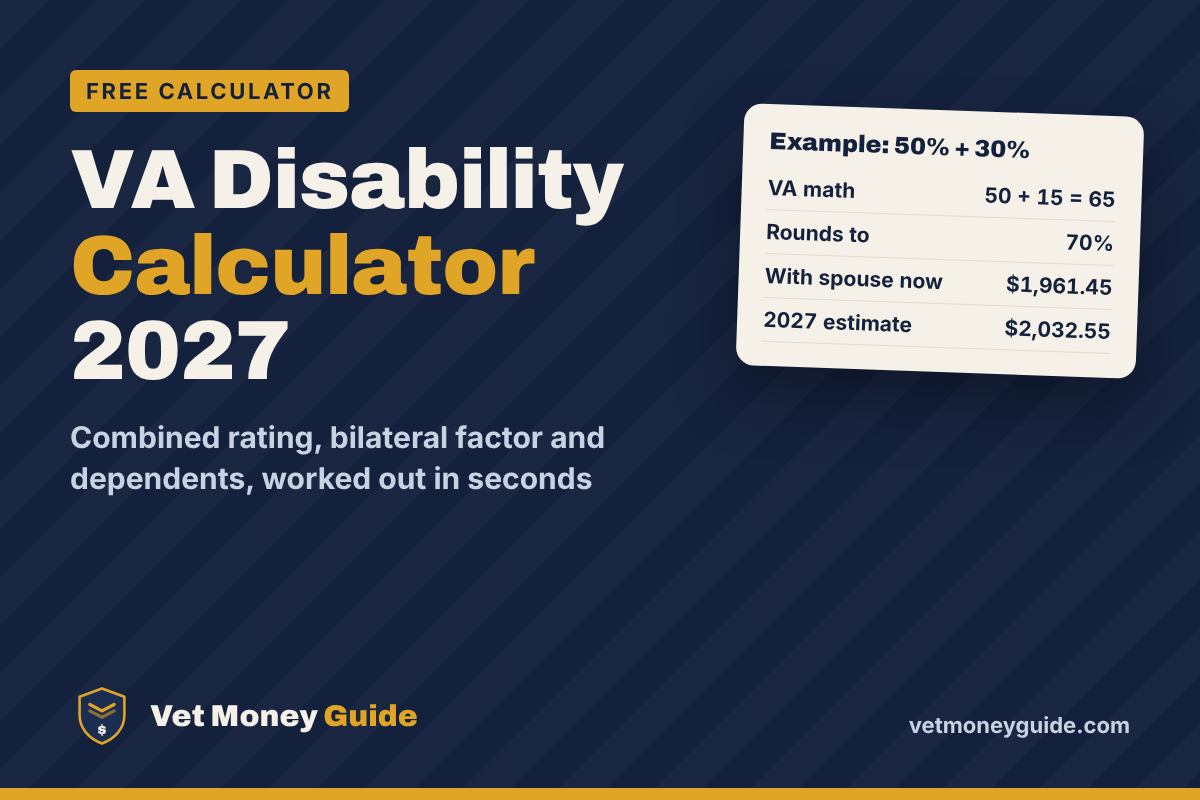
- VA does not add ratings: 50% + 30% is paid at 70%, which is $1,808.45 a month for a veteran alone.
VA Disability Calculator 2027
Combined rating (VA math, with the bilateral factor), plus dependents. Shows VA’s official monthly rate now and a 2027 estimate using the announced 3.6% COLA. Rates checked October 28, 2026.
How this calculator works (and its limits)
- VA math (38 CFR 4.25): ratings are sorted from highest to lowest. Each next rating applies only to the “remaining” percentage. Each step is rounded to a whole number. The final value is rounded to the nearest 10, and 5 rounds up. That last rounding happens only once.
- Bilateral factor (38 CFR 4.26): paired-limb ratings are combined first, then 10% of that value is added (not combined). The result counts as one rating. If leaving the factor out gives a higher result, the calculator uses that instead, as 4.26(d) says.
- Official rates: VA.gov, effective December 1, 2025.
- 2027 estimate:
- Veteran-alone rates and all 100% amounts are multiplied by 1.036 and rounded to the cent.
- At 30% to 90%, dependent amounts are a share of the 100% amount with the cents dropped (38 U.S.C. 1115). This method reproduces every official dependent row in the current table.
- Expect VA’s final numbers to differ by a few cents, and sometimes by $1.
- Children: the first child is in the base “with child” rate, and each extra child adds VA’s “additional child” amount. If all your children are 18 to 23 and in school, we count one of them in the base rate. That is our assumption, so confirm it with VA.
- TDIU check: checks only the percentage rule in 38 CFR 4.16(a). Paired-limb ratings count as one disability.
- Not included:
- Special monthly compensation (SMC)
- A TDIU decision (only VA decides)
- Retired pay offsets (CRDP or CRSC)
- Back pay
- Ratings that are not multiples of 10
- Privacy: everything runs in your browser. Nothing you enter is sent or saved.
Sources: VA rates · 38 CFR 4.25 · 38 CFR 4.26 · 38 U.S.C. 1115 · 38 CFR 4.16 · SSA 3.6% COLA · S. 4487
Education only. Not legal or financial advice. Not affiliated with VA or DoD. For help with your own claim, a VA-accredited VSO helps for free: find one on VA.gov.
How to use the calculator, field by field
Have your latest VA decision letter handy. You need two things from it: each separate rating, and the dependents VA has on your award.
Step 1: Your separate VA ratings
Enter each rating on its own row, in steps of 10. The calculator opens with 50 and 30 filled in, because that is the example VA uses in its own regulation. Change them to yours. Use + Add a rating for more rows. Order doesn’t matter here, because the calculator sorts them from highest to lowest the way VA does.
A 0% rating is fine to enter, but it won’t change the math. It adds nothing to the combined value.
The “paired limb (bilateral)” box
Each row has a checkbox. Tick it only for a rating on an arm or a leg (or a paired skeletal muscle) when the matching limb on the other side also has a rating of 10% or more. Think left knee and right knee, both rated. When two or more rows are ticked, the calculator applies the bilateral factor from 38 CFR 4.26, then checks the math both ways and keeps the higher result, as the regulation says.
Watch out: if you tick only one row, there is no pair, so the calculator shows a warning and does not apply the factor. Two ratings on the same side of the body are not a bilateral pair.
The shortcut: “I already know my combined rating”
If your letter already shows your combined rating and you only want the dollars, tick this box and pick your rating from the list. It skips the VA math and goes straight to pay. If you want to check VA’s math instead, leave it off and enter the separate ratings.
Step 2: Dependents on your award
| Field | What to enter | Good to know |
|---|---|---|
| Spouse | Tick if VA has your spouse on your award | Married but not added? VA pays you the veteran-alone rate |
| Spouse receives Aid and Attendance | Tick only if VA pays the A&A add-on for your spouse | Unlocks only after you tick Spouse |
| Children under 18 | Number of children, 0 to 15 | The first child is in the base rate; each extra child adds VA’s “additional child” amount |
| Children 18 to 23 in school | Number of children, 0 to 15 | Each extra school child adds VA’s school-child amount, which is larger than the under-18 add-on |
| Dependent parents | 0, 1 or 2 | Only parents VA has added as your dependents |
Two rules decide whether these boxes matter. First, VA adds dependent pay only at a combined rating of 30% or higher. Second, it pays only for dependents VA has actually added to your award, not everyone in your house. Then hit Calculate. Reset clears everything.
Tip: nothing you type is saved or sent anywhere. The calculator runs entirely in your browser, so it’s safe to plug in your real numbers.
What your result means
The results come in three layers.
- Your combined rating. You see the combined value before final rounding (for example, 65) and the rating VA pays (70%). You also see the band, such as “Values from 65 to 74 round to 70%. A combined value of 75 would round to 80%.” Open “Show the VA math, step by step” to see every line.
- The OFFICIAL card. Your monthly and yearly amount on VA’s current table, effective December 1, 2025. This is what VA pays today for that rating and household.
- The ESTIMATE cards. Dashed border, amber background, “ESTIMATE” tag. They show the 2027 monthly and yearly amounts with the 3.6% COLA, plus the change from today. We styled them that way on purpose, so a screenshot can’t pass for an official table.
Yearly amounts are the monthly rate times 12, a budgeting number that ignores any rate change partway through the year.
Below 100%, you also get a collapsible TDIU percentage check. It tests only the percentage rule in 38 CFR 4.16(a): one disability at 60% or more, or two or more disabilities with one at 40% or more and a combined 70% or more. TDIU pays at the 100% rate, so the panel shows that rate with your dependents. Meeting the percentages is not the same as getting TDIU. Only VA decides, and it also looks at whether your service-connected disabilities keep you from substantially gainful work.
Tip: if the OFFICIAL card doesn’t match your deposit, check two things first. Is every dependent actually on your award? Did you enter every rating from your letter? Military retirees: this calculator doesn’t model retired pay offsets, so your VA deposit can look different.
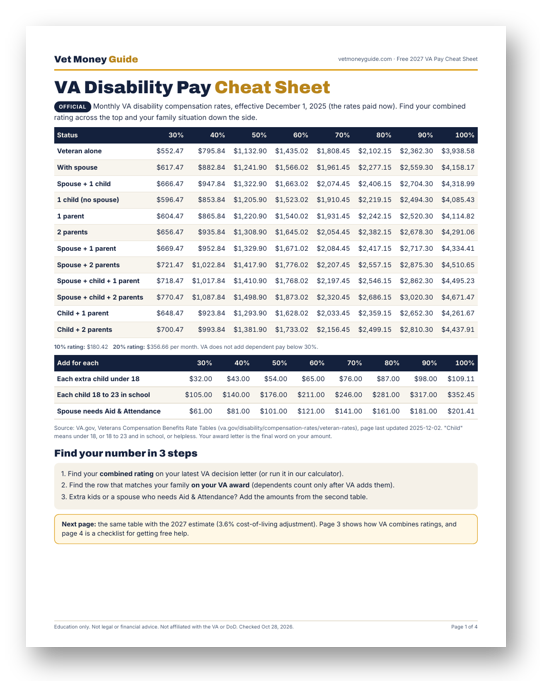
Free: the 2027 VA Pay Cheat Sheet
Every VA disability rate on one page, the 2027 estimate with the 3.6% COLA, the combined rating math, and a checklist for free VSO help. 4 printable pages.
Three worked examples
These are example veterans, not real people. Each one was run through the same engine the calculator uses, with VA’s official table and our 2027 estimate table. Plug the same inputs in above and you’ll get the same answers.
Example 1: Single veteran, three ratings (30, 20 and 10)
Add 30, 20 and 10 and you get 60. VA doesn’t add, so here is what the calculator does instead.
Inputs: 30%, 20%, 10%. No dependents.
Start with 30. Remaining: 70.
20% of the remaining 70 = 14. 30 + 14 = 44. Remaining: 56.
10% of the remaining 56 = 5.6. 44 + 5.6 = 49.6, kept as the whole number 50.
Round 50 to the nearest 10 = 50%.
Official now: $1,132.90 a month, $13,594.80 a year.
2027 estimate: $1,173.68 a month, $14,084.16 a year. Change: +$40.78 a month, +$489.36 a year.
If you had budgeted on 60%, you’d have planned on $1,435.02. That’s $302.12 a month more than VA math gives. It’s an easy mistake to make, and the calculator catches it in one click.
Example 2: Married, two kids under 18, four ratings (50, 30, 20 and 10)
Inputs: 50%, 30%, 20%, 10%. Spouse. 2 children under 18.
Start with 50. Remaining: 50.
30% of 50 = 15. 50 + 15 = 65. Remaining: 35.
20% of 35 = 7. 65 + 7 = 72. Remaining: 28.
10% of 28 = 2.8. 72 + 2.8 = 74.8, kept as 75.
75 ends in 5, so it rounds up = 80%.
Pay, official now: 80% with spouse and 1 child = $2,406.15. Plus 1 additional child under 18 = $87.00. Total $2,493.15 a month, $29,917.80 a year.
Pay, 2027 estimate: $2,492.83 + $90.00 = $2,582.83 a month, $30,993.96 a year. Change: +$89.68 a month, +$1,076.16 a year.
Two lessons here. The small 10% rating mattered: it moved the combined value from 72 to 75, and 75 rounds up. And the family matters: the spouse and kids add $391.00 a month on top of the 80% veteran-alone rate of $2,102.15.
Example 3: Both knees rated, spouse, one child under 18 and one in college
This veteran has a 50% rating, plus 20% on one knee and 10% on the other. Both knee rows get the “paired limb” tick. One child is under 18 and one is 19 and in school.
Inputs: 50%, 20% (paired limb), 10% (paired limb). Spouse. 1 child under 18. 1 child 18 to 23 in school.
Bilateral step: 20 and 10 combine to 28. Add 10% of 28 (2.8) = 30.8, kept as 31.
Start with 50. Remaining: 50.
31% of 50 = 15.5. 50 + 15.5 = 65.5, kept as 66.
Round 66 = 70%. (Without the bilateral factor: 50, 20, 10 combine to 64, which rounds to 60%.)
Pay, official now: 70% with spouse and 1 child = $2,074.45. Plus 1 school child = $246.00. Total $2,320.45 a month, $27,845.40 a year.
Pay, 2027 estimate: $2,148.55 + $255.00 = $2,403.55 a month, $28,842.60 a year. Change: +$83.10 a month, +$997.20 a year.
The bilateral factor is the difference between 60% and 70% here. VA applies it on its own, but now you can see it on paper. Our VA combined rating calculator guide walks through the bilateral rule in more depth.
| Example | Ratings | Paid at | Household | Official now | 2027 estimate | Change per month |
|---|---|---|---|---|---|---|
| 1 | 30, 20, 10 | 50% | Veteran alone | $1,132.90 | $1,173.68 | +$40.78 |
| 2 | 50, 30, 20, 10 | 80% | Spouse, 2 kids under 18 | $2,493.15 | $2,582.83 | +$89.68 |
| 3 | 50, 20 + 10 bilateral | 70% | Spouse, 1 kid under 18, 1 in school | $2,320.45 | $2,403.55 | +$83.10 |
Watch out: at 10% and 20%, dependents don’t change the rate. Two 10% ratings combine to 19, which rounds to 20%. That pays $356.66 a month whether you’re single or married with three kids (about $369.50 in 2027, estimate). The calculator shows a warning if you enter dependents at these ratings.
Where the 2027 estimate comes from
On October 14, 2026, the Social Security Administration announced a 3.6% cost-of-living adjustment for 2027. VA disability pay doesn’t change automatically when that happens. Congress passes a short bill each year. This year’s is the Veterans’ Compensation Cost-of-Living Adjustment Act of 2026, S. 4487 in the Senate and H.R. 8552 in the House.
The bill text sets the increase at the same percentage as Social Security, effective December 1, 2026. When we checked in late October 2026, it had not passed. Until it passes and VA posts its new table, every 2027 VA number online is an estimate, including ours.
Here is exactly how we built the estimate, so you can check it:
- Veteran-alone rates and every 100% amount: today’s rate times 1.036, rounded to the cent. Example: $3,938.58 becomes $4,080.37.
- Dependent amounts at 30% to 90%: under 38 U.S.C. 1115, these are a share of the 100% dependent amount, and amounts that aren’t a whole dollar are rounded down. That rule reproduces every dependent row in VA’s current table exactly, so we apply it to the 2027 numbers too.
- Spouse Aid and Attendance at 30% to 70%: VA’s published amounts run $1 higher than the rule gives, so our estimate for that add-on may be $1 low.
We also tested the method on last year’s raise. VA’s rates effective December 1, 2024, times 1.028 (last year’s COLA), give exactly the rates VA published for December 1, 2025. For example, $3,831.30 times 1.028 is $3,938.58. So expect VA’s final 2027 table to land within a few cents of ours, and possibly $1 off on some dependent rows. When VA posts the official table, we’ll update the calculator.
Tip: you don’t apply for the COLA. Once the law passes, VA applies it to your award automatically. For the full rate-by-rate picture, see the VA disability increase 2027 breakdown.
What this calculator does not do
This calculator does not cover:
- Special monthly compensation (SMC). SMC, including SMC-K, isn’t part of this calculator.
- A TDIU decision. The panel checks percentages only. VA decides TDIU.
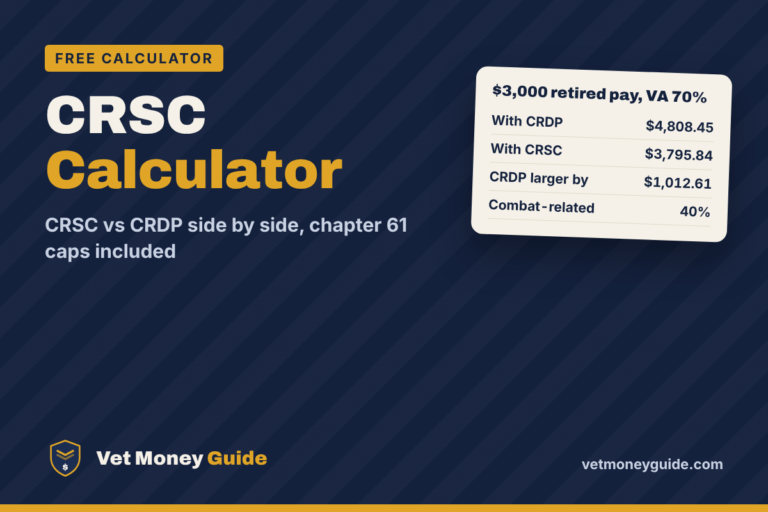
- Retired pay offsets. CRDP and CRSC are not modeled. Retirees should treat the result as the VA side only.
- Back pay. It shows a monthly rate, not what you’re owed from an effective date.
- Ratings that aren’t multiples of 10. Enter ratings as they appear on your letter, in steps of 10.
- Rating opinions. It can’t tell you what any condition should be rated. VA rates each condition using its rating schedule (38 CFR Part 4).
One assumption to know about. If all of your children are 18 to 23 and in school, with none under 18, the calculator counts one of them in the base “with child” rate and adds the school-child amount for the rest. That is our reading, and the calculator says so. Confirm it with VA if it applies to you.
When to talk to a VSO
The calculator checks math. It can’t look at your file. Talk to a free VA-accredited Veterans Service Organization (VSO) representative when:
- Your combined rating on the calculator doesn’t match your decision letter.
- Your deposit doesn’t match the OFFICIAL card and you’ve ruled out a missing rating.
- You got married, had a baby or adopted, and the dependent isn’t on your award yet. VA says to file within a year of the marriage, birth or adoption to get paid back to that date.
- You have paired-limb ratings and aren’t sure VA applied the bilateral factor.
- The TDIU panel says you meet the percentages and you want to know what comes next.
VA says the services an accredited VSO representative provides on your claim “are always free.” As an Army veteran, my advice is simple: bring your letter and your calculator printout, and ask one sharp question. You can find an accredited representative on VA.gov’s find-a-rep tool.
Watch out: skip paid “claim consultants” who aren’t accredited. Only VA-accredited attorneys and claims agents may charge for VA claim help, and accredited VSOs help for free. You can check anyone’s accreditation on VA’s website before you pay a dime.
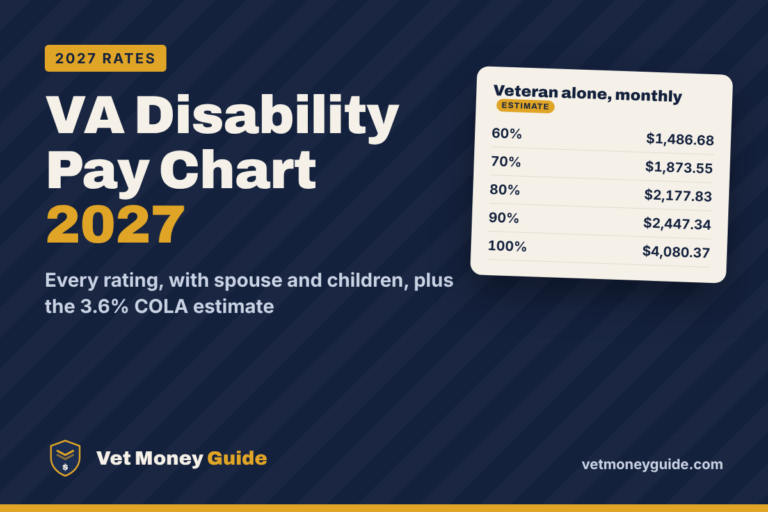
VA Disability Pay Chart 2027: Every Rating, With Spouse and Children
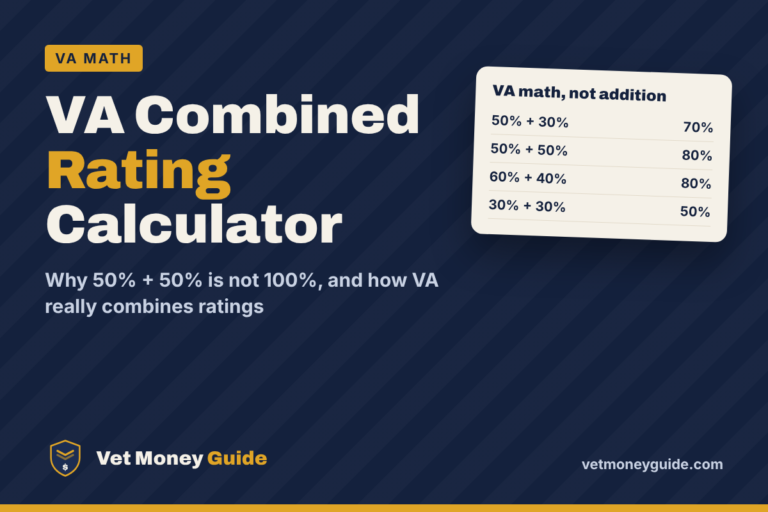
VA Combined Rating Calculator: How VA Math Works
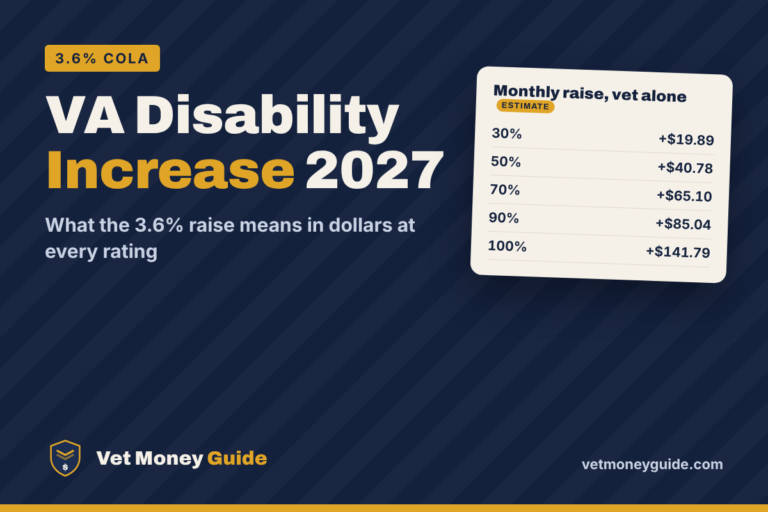
VA Disability Increase 2027: The 3.6% COLA in Dollars
FAQ
Is there a VA disability calculator for 2027?
Yes, this one shows VA’s official rate now next to a 2027 estimate with the 3.6% COLA. At 100% for a veteran alone, that’s $3,938.58 now and about $4,080.37 in 2027. The 2027 side stays an estimate until Congress passes the COLA bill and VA publishes its table, and we’ll update it when that happens.
Does the VA disability calculator include dependents?
Yes: spouse, spouse Aid and Attendance, children under 18, children 18 to 23 in school, and up to two dependent parents. Dependents count only at 30% and up. At 70% with a spouse and one child, VA pays $2,074.45 a month, compared with $1,808.45 for a veteran alone.
Does it work as a VA disability calculator with bilateral factor?
Yes. Tick “paired limb” on each arm or leg rating that has a rated match on the other side. The calculator combines the pair, adds 10% of that value, and checks the result both ways under 38 CFR 4.26(d). In Example 3 above, it turns 60% into 70%.
Can the calculator figure back pay or SMC-K?
No. It shows the monthly rate for your combined rating and dependents. Back pay depends on your effective date, and SMC isn’t part of this calculator. A free VSO can help you check either one.
How much does 100% VA disability pay per month?
On VA’s current table, 100% pays $3,938.58 a month for a veteran alone and $4,158.17 with a spouse. Our 2027 estimates are about $4,080.37 and $4,307.86. Enter your own household in the calculator to see your exact row.

Sources (checked October 28, 2026)
- VA, Current Veterans disability compensation rates (effective December 1, 2025)
- VA, Past rates effective December 1, 2024 (used to test the estimate method)
- 38 CFR 4.25, Combined ratings table (Cornell LII)
- 38 CFR 4.26, Bilateral factor (Cornell LII)
- 38 CFR 4.16, Total disability ratings for compensation based on unemployability (Cornell LII)
- 38 U.S.C. 1115, Additional compensation for dependents (Cornell LII)
- SSA, 3.6% COLA for 2027 (October 14, 2026)
- S. 4487, Veterans’ Compensation Cost-of-Living Adjustment Act of 2026 (GovInfo)
- VA, Add or remove dependents
- VA, Accredited representative FAQs
- VA, Find a VA-accredited representative