VA Combined Rating Calculator: How VA Math Works (Bilateral Factor Included)
Education only, not legal or financial advice. Not affiliated with the VA or DoD. Numbers checked against official sources on October 28, 2026. Disclosures.
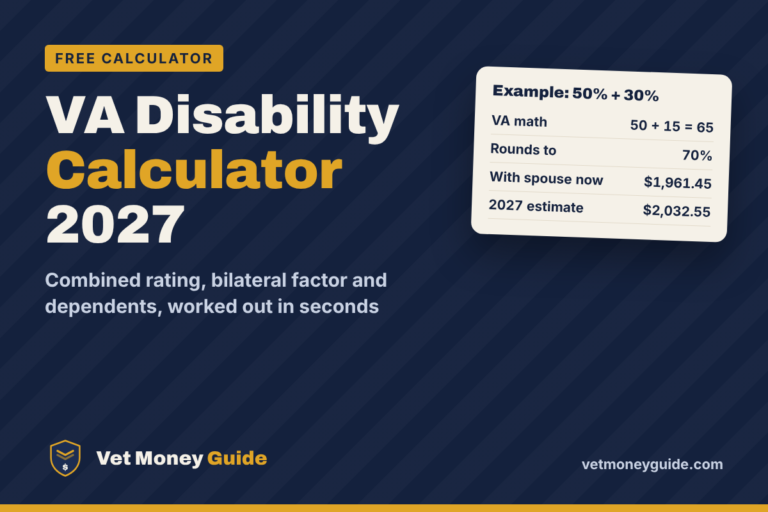
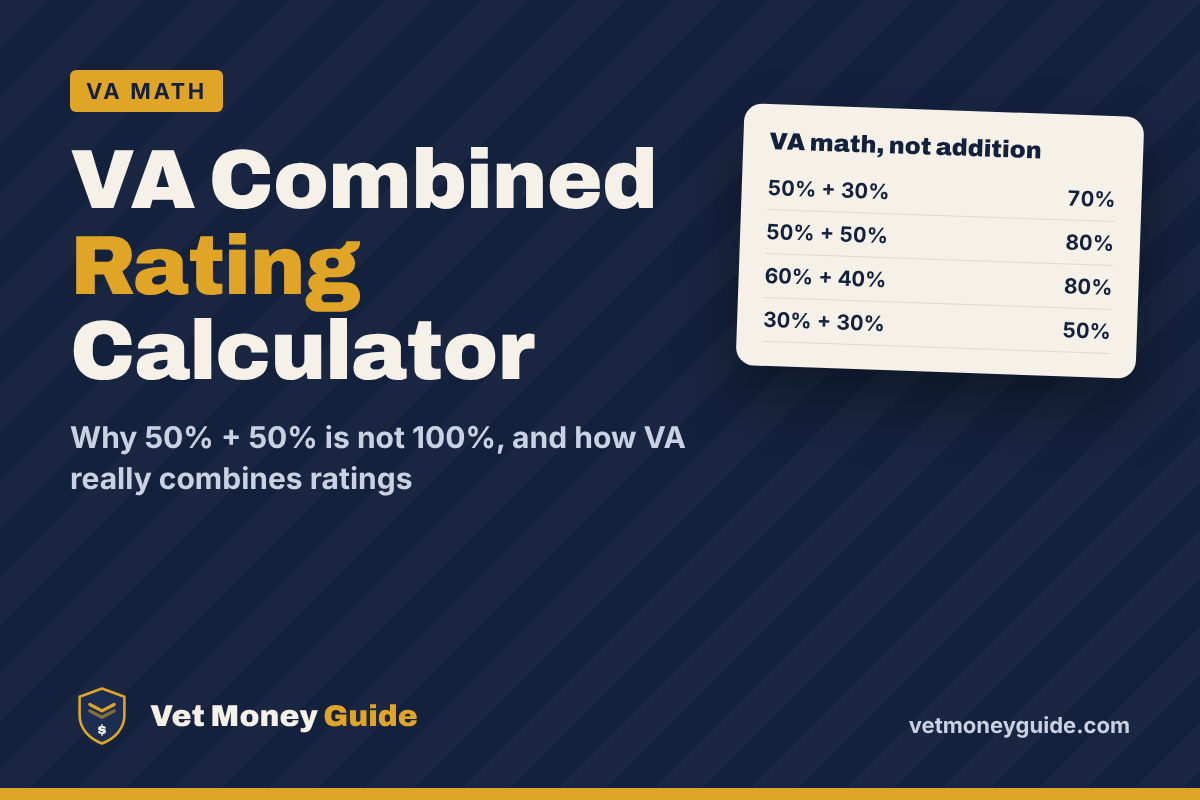
A VA combined rating calculator has one job: combine your separate ratings the way VA does under 38 CFR 4.25, and VA does not add them. A 50% rating and a 30% rating combine to 65, which VA rounds to 70%. Two 30% ratings combine to 51, which rounds down to 50%. Two 50% ratings combine to 75, which rounds up to 80%.
This page explains why, one step at a time, using the examples VA puts in its own regulation. It covers the combined ratings table, the rounding rule, the bilateral factor in 38 CFR 4.26, and how far you are from the next 10%. The calculator below shows your unrounded value and every line of the math.
Quick answer
- Sort high to low. Each next rating applies only to the “efficiency” that’s left, not to 100.
- Keep whole numbers at each step. Round to the nearest 10 only once, at the end. A value ending in 5 rounds up.
- 50 + 30 = 65, paid at 70%. 30 + 30 = 51, paid at 50%. 50 + 50 = 75, paid at 80%.
- Bilateral factor: combine paired-limb ratings, add 10% of that value, then treat the result as one rating.
- The rounding line: combined values of 65 to 74 pay at 70% ($1,808.45 alone); 75 to 84 pay at 80% ($2,102.15 alone).
VA Disability Calculator 2027
Combined rating (VA math, with the bilateral factor), plus dependents. Shows VA’s official monthly rate now and a 2027 estimate using the announced 3.6% COLA. Rates checked October 28, 2026.
How this calculator works (and its limits)
- VA math (38 CFR 4.25): ratings are sorted from highest to lowest. Each next rating applies only to the “remaining” percentage. Each step is rounded to a whole number. The final value is rounded to the nearest 10, and 5 rounds up. That last rounding happens only once.
- Bilateral factor (38 CFR 4.26): paired-limb ratings are combined first, then 10% of that value is added (not combined). The result counts as one rating. If leaving the factor out gives a higher result, the calculator uses that instead, as 4.26(d) says.
- Official rates: VA.gov, effective December 1, 2025.
- 2027 estimate:
- Veteran-alone rates and all 100% amounts are multiplied by 1.036 and rounded to the cent.
- At 30% to 90%, dependent amounts are a share of the 100% amount with the cents dropped (38 U.S.C. 1115). This method reproduces every official dependent row in the current table.
- Expect VA’s final numbers to differ by a few cents, and sometimes by $1.
- Children: the first child is in the base “with child” rate, and each extra child adds VA’s “additional child” amount. If all your children are 18 to 23 and in school, we count one of them in the base rate. That is our assumption, so confirm it with VA.
- TDIU check: checks only the percentage rule in 38 CFR 4.16(a). Paired-limb ratings count as one disability.
- Not included:
- Special monthly compensation (SMC)
- A TDIU decision (only VA decides)
- Retired pay offsets (CRDP or CRSC)
- Back pay
- Ratings that are not multiples of 10
- Privacy: everything runs in your browser. Nothing you enter is sent or saved.
Sources: VA rates · 38 CFR 4.25 · 38 CFR 4.26 · 38 U.S.C. 1115 · 38 CFR 4.16 · SSA 3.6% COLA · S. 4487
Education only. Not legal or financial advice. Not affiliated with VA or DoD. For help with your own claim, a VA-accredited VSO helps for free: find one on VA.gov.
The whole person idea
VA starts from one idea in 38 CFR 4.25: a person is 100% “efficient.” Each disability rating takes a bite out of whatever efficiency is left, not out of the original 100.
Picture a bar split into 100 blocks. A 50% rating shades 50 of them. That leaves 50 unshaded. Now a 30% rating comes along. It doesn’t shade 30 more blocks. It shades 30% of the 50 that are left, which is 15 blocks. Total shaded: 65.
That’s the whole trick, and it explains everything else on this page. Every new rating has less “person” left to bite, so ratings stack slower and slower as you climb. It’s also why adding your ratings almost always overshoots. A veteran with 50, 30, 20 and 10 can add them up to 110, but no one is more than 100% of a person.
VA math step by step (38 CFR 4.25)
Here is the method in four steps. It’s the same method the calculator above runs.
- Sort your ratings from highest to lowest. Ignore 0% ratings; they add nothing.
- Start with the highest rating.
- Apply each next rating to the remaining efficiency (100 minus what you have so far), add it on, and keep a whole number.
- Round once, at the very end, to the nearest 10. A value ending in 5 rounds up.
VA’s simplest example is 50 and 30.
VA’s example: 50% and 30%
Start with 50. Remaining: 100 minus 50 = 50.
30% of the remaining 50 = 15.
50 + 15 = 65 (the combined value).
65 ends in 5, so it rounds up = 70%.
With three or more ratings, you keep going. Here is the three-rating example from the same regulation.
VA’s example: 60%, 40% and 20%
Start with 60. Remaining: 40.
40% of 40 = 16. 60 + 16 = 76. Remaining: 24.
20% of 24 = 4.8. 76 + 4.8 = 80.8, kept as the whole number 81.
Round 81 to the nearest 10 = 80%.
Notice where the rounding happened. The 80.8 became 81, a whole number, but nothing got rounded to a 10 until the very last line. That single final rounding is the part most people (and a lot of online calculators) get wrong.
Tip: the calculator shows the same lines under “Show the VA math, step by step.” Put your decision letter next to it and check each step against VA’s combined rating.
How the combined ratings table works
People search for the “VA combined rating table” or a “table PDF.” The official one is Table I in 38 CFR 4.25 itself, and you can read it free on Cornell’s Legal Information Institute site (linked in the sources below). It does the same arithmetic you just saw, laid out as a grid.
- Find your highest rating in the left column.
- Find your next rating across the top.
- The cell where they meet is the combined value. Row 50, column 30 is 65.
- For a third rating, find that combined value (65) in the left column and read across to the third rating.
- Repeat until you run out of ratings. Then round the last value to the nearest 10.
The table also confirms the “whole number at each step” rule. Row 65, column 10 shows 69. The raw math is 65 plus 10% of the remaining 35, which is 65 + 3.5 = 68.5. The table gives 69, so a half rounds up to the next whole number at each step. Our calculator follows the same rule, which is why its answers match the table cell for cell.
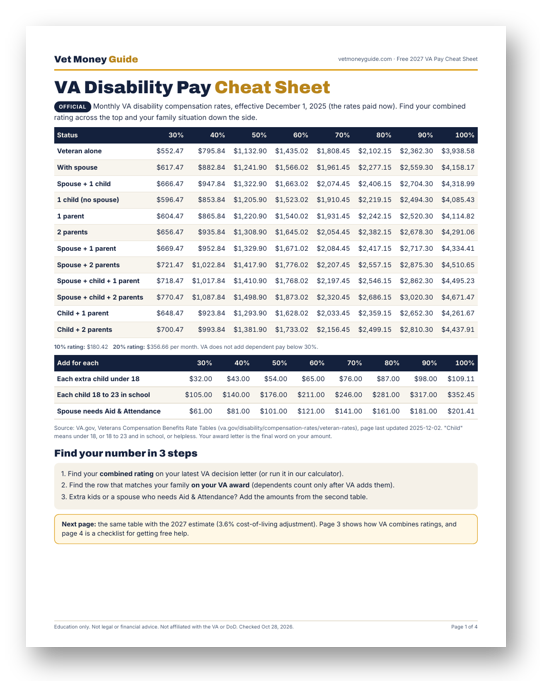
Free: the 2027 VA Pay Cheat Sheet
Every VA disability rate on one page, the 2027 estimate with the 3.6% COLA, the combined rating math, and a checklist for free VSO help. 4 printable pages.
Common surprises, checked
Every row below was run through our reference code, which follows 38 CFR 4.25 line by line. The middle column is what you’d get by adding. The last column is what VA pays.
| Ratings | If you add them | VA combined value | Paid at |
|---|---|---|---|
| 50 + 30 | 80 | 65 | 70% |
| 40 + 20 | 60 | 52 | 50% |
| 30 + 30 | 60 | 51 | 50% |
| 50 + 50 | 100 | 75 | 80% |
| 60 + 60 | 120 | 84 | 80% |
| 60 + 40 + 20 | 120 | 81 | 80% |
| 30 + 20 + 10 | 60 | 50 | 50% |
| 50 + 30 + 20 + 10 | 110 | 75 | 80% |
| 90 + 10 | 100 | 91 | 90% |
| 90 + 50 | 140 | 95 | 100% |
A few of these deserve a closer look.
50 + 50 = 75, which becomes 80. Start at 50, take 50% of the remaining 50, and you add 25. The combined value is 75, it ends in 5, and 5 rounds up. Two 50s land on 80%, not 100%.
30 + 30 = 51, which becomes 50. Start at 30, take 30% of the remaining 70, and you add 21. That’s 51, and 51 rounds down. In dollars, a veteran alone who expected 60% ($1,435.02 a month) is paid at 50% ($1,132.90), a gap of $302.12 a month.
90 + 10 = 91. At 90, only 10 points of efficiency are left. A 10% rating takes 10% of that, which is 1 point. Getting from 90 to 100% needs a combined value of 95. In the table above, 90 + 50 gets there, because 50% of the remaining 10 is 5.
How many 10% ratings make 30%?
| Number of 10% ratings | Combined value | Paid at |
|---|---|---|
| 1 | 10 | 10% |
| 2 | 19 | 20% |
| 3 | 27 | 30% |
| 4 | 34 | 30% |
| 5 | 41 | 40% |
Three 10s reach 30%. A fourth only gets you to 34, which still rounds to 30%. It takes five to reach 40%. Each 10 bites a smaller piece: 10, then 9, then 8.1, then 7.3, then 6.6.
The bilateral factor (38 CFR 4.26)
There’s one exception to plain VA math, and it works in the veteran’s favor. Under 38 CFR 4.26, when both arms, both legs, or paired skeletal muscles each have a compensable rating (10% or more), VA handles the pair differently:
- Combine just the paired ratings with normal VA math. Don’t round to a 10.
- Add 10% of that combined value. This 10% is added, not combined.
- Keep a whole number. That result now counts as one rating.
- Sort it in with your other ratings and combine everything as usual.
Here is VA’s own example from the regulation: ratings of 60% and 20%, plus a 10% on each side that qualify as bilateral.
VA’s example: 60%, 20%, and 10% + 10% bilateral
Bilateral pair: 10 and 10 combine to 19. Add 10% of 19 (1.9) = 20.9, kept as 21.
Sort: 60, 21, 20.
Start with 60. 21% of the remaining 40 = 8.4. 60 + 8.4 = 68.4, kept as 68.
20% of the remaining 32 = 6.4. 68 + 6.4 = 74.4, kept as 74.
Round 74 = 70%.
In VA’s example, the factor didn’t change the final rating. Without it, 60, 20, 10 and 10 also combine to 74, which is 70%. Here’s a case where it does change the result. This one is our example, not VA’s: a veteran whose only two ratings are 30% on each leg.
Our example: 30% + 30%, both legs
Without the factor: 30 + 30% of the remaining 70 (21) = 51. Round = 50%.
With the factor: 30 and 30 combine to 51. Add 10% of 51 (5.1) = 56.1, kept as 56. It’s the only rating, so round 56 = 60%.
In dollars (veteran alone): 60% is $1,435.02 a month, compared with $1,132.90 at 50%, a difference of $302.12. Using our 2027 estimates, it’s $1,486.68 compared with $1,173.68, a difference of $313.00 (estimate).
There’s also a safety rule. Paragraph (d) of 4.26 says that if leaving a disability out of the bilateral factor gives a higher rating, VA leaves it out. Our calculator runs the math both ways and keeps whichever is higher, so you never get a worse answer by ticking the box.
Watch out: the factor needs a pair. One rated knee is not bilateral, and two ratings on the same side of the body are not a pair. If you tick “paired limb” on only one row, the calculator warns you and skips the factor.
The rounding line and the gap to the next 10%
VA pays by the final rating, so every combined value falls into a band. Here is each band with VA’s current monthly rate for a veteran alone and our 2027 estimate.
| Combined value | Paid at | Veteran alone, official now | 2027 estimate |
|---|---|---|---|
| 10 to 14 | 10% | $180.42 | $186.92 |
| 15 to 24 | 20% | $356.66 | $369.50 |
| 25 to 34 | 30% | $552.47 | $572.36 |
| 35 to 44 | 40% | $795.84 | $824.49 |
| 45 to 54 | 50% | $1,132.90 | $1,173.68 |
| 55 to 64 | 60% | $1,435.02 | $1,486.68 |
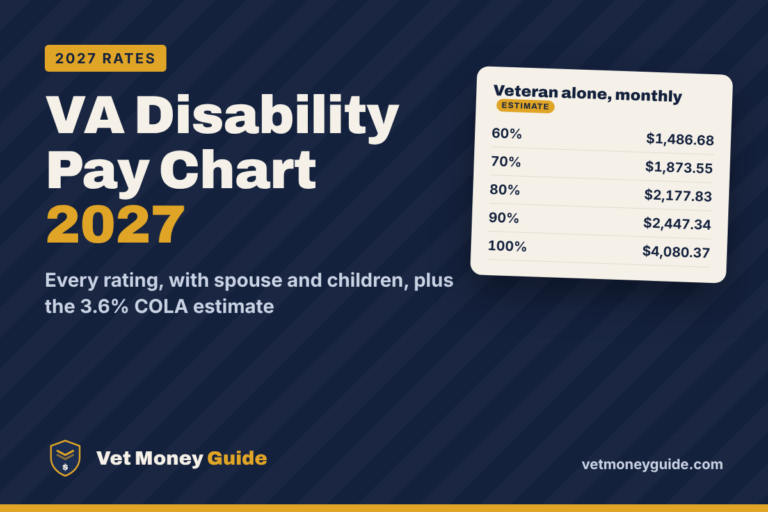
| 65 to 74 | 70% | $1,808.45 | $1,873.55 |
| 75 to 84 | 80% | $2,102.15 | $2,177.83 |
| 85 to 94 | 90% | $2,362.30 | $2,447.34 |
| 95 and up | 100% | $3,938.58 | $4,080.37 |
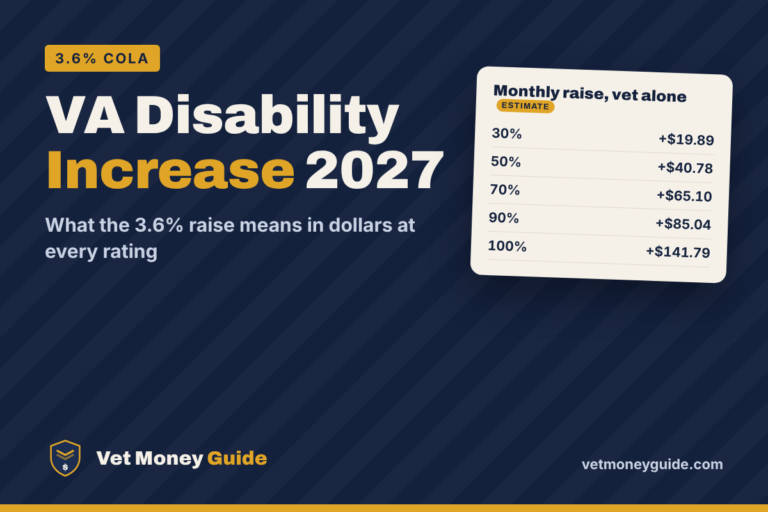
The 2027 column is an estimate. SSA announced a 3.6% COLA on October 14, 2026, but VA hasn’t published its 2027 table, and the COLA bill (S. 4487 / H.R. 8552) had not passed when we checked in late October 2026.
A single point can move you across a line. A combined value of 74 pays at 70%. A combined value of 75 pays at 80%. For a veteran alone, that’s $1,808.45 compared with $2,102.15, a gap of $293.70 a month at today’s rates and $304.28 using our 2027 estimates.
That’s why the calculator shows your unrounded value and your band, worded like this: “Values from 65 to 74 round to 70%. A combined value of 75 would round to 80%.” The distance from your value to the next line is your gap to the next 10%.
Why points get harder to gain as you climb
| Starting combined value | Add one 10% rating | Points gained | Paid at |
|---|---|---|---|
| 30 | 37 | 7 | 40% |
| 50 | 55 | 5 | 60% |
| 70 | 73 | 3 | 70% |
| 90 | 91 | 1 | 90% |
The same 10% rating is worth 7 points at 30 and just 1 point at 90. The higher your combined value, the less efficiency is left for any new rating to bite.
Watch out: the gap is for reading your letter, not for chasing a number. VA rates each condition on its own evidence under its rating schedule (38 CFR Part 4). If you think a rating or the combined math on your letter is wrong, a free VA-accredited VSO can review it with you. Find one on VA.gov.
Four mistakes that break VA math
Before you trust any VA combined rating calculator, including a spreadsheet you built yourself, check it for these.
- Adding. 50 plus 30 is not 80 in VA math. It’s 65, paid at 70%.
- Rounding at every step. If you round 65 up to 70 before applying the next rating, you’ll get the wrong answer. Keep whole numbers in between and round to a 10 only once, at the end.
- Starting with the wrong rating. Order changes the whole numbers at each step, so VA sorts from the most severe to the least. Always start with your highest rating.
- Combining the bilateral 10% instead of adding it. The extra 10% of the paired value is added straight on (51 + 5.1), not run through VA math like another rating.
As an Army veteran, I’ll say the obvious part out loud: VA does this math for you, and you don’t have to master it to get paid. But knowing it lets you read your own decision letter, and walk into a VSO office with a sharp question instead of a vague worry.
Your combined rating sets which row of the pay table you’re on. Your dependents set the dollars within that row. To see both together, with a spouse, kids or parents, use the full VA disability calculator guide.
VA Disability Calculator 2027: Combined Rating + Dependents (Free)
VA Disability Pay Chart 2027: Every Rating, With Spouse and Children
VA Disability Increase 2027: The 3.6% COLA in Dollars
FAQ
How does VA calculate a combined disability rating?
VA sorts your ratings from highest to lowest and applies each one to the efficiency that’s left, keeping whole numbers. It rounds to the nearest 10 once at the end, and 5 rounds up. That’s why 60, 40 and 20 come to 81, which is paid at 80%.
What is 50% and 30% combined in VA math?
50% and 30% combine to 65, which rounds up to 70%. It’s the example VA uses in 38 CFR 4.25. For a veteran alone, 70% pays $1,808.45 a month on VA’s current table, not the $2,102.15 people expect for 80%.
How many 10% ratings does it take to get 30%?
Three. Two 10s combine to 19 (20%), and three combine to 27 (30%). A fourth only reaches 34, which still rounds to 30%, and it takes five to reach 41 (40%).
Where is the VA combined rating table PDF?
The official table is Table I in 38 CFR 4.25, and Cornell’s Legal Information Institute publishes the full regulation free online. Find your highest rating on the left, your next rating across the top, and read the cell. Row 50, column 30 gives 65.
Does the bilateral factor always raise my combined rating?
No. In VA’s own 4.26 example (60, 20, and 10 + 10 bilateral), the combined value is 74 either way, so the rating stays 70%. In our 30% + 30% example, it moves the result from 51 (50%) to 56 (60%). Under 4.26(d), VA uses whichever way gives the higher rating.
Does a 0% rating change my combined rating?
No. A 0% rating adds nothing to the combined value, so 50% and 0% is still 50%. It has no monthly payment by itself, but it can still matter for other benefits.

Sources (checked October 28, 2026)
- 38 CFR 4.25, Combined ratings table (Cornell LII)
- 38 CFR 4.26, Bilateral factor (Cornell LII)
- VA, Current Veterans disability compensation rates (effective December 1, 2025)
- SSA, 3.6% COLA for 2027 (October 14, 2026)
- S. 4487, Veterans’ Compensation Cost-of-Living Adjustment Act of 2026 (GovInfo)
- VA, Find a VA-accredited representative