Military to Civilian Resume: Examples, Template and a Free Bullet Translator
Education only, not legal or financial advice. Not affiliated with the VA or DoD. Numbers checked against official sources on October 28, 2026. Disclosures.
A military to civilian resume takes what you did in uniform and says it in words a civilian hiring manager understands on the first read. That means three moves: swap military terms for civilian ones, replace your rank with a job title that matches your duties, and turn each duty into a result with a real number in it.
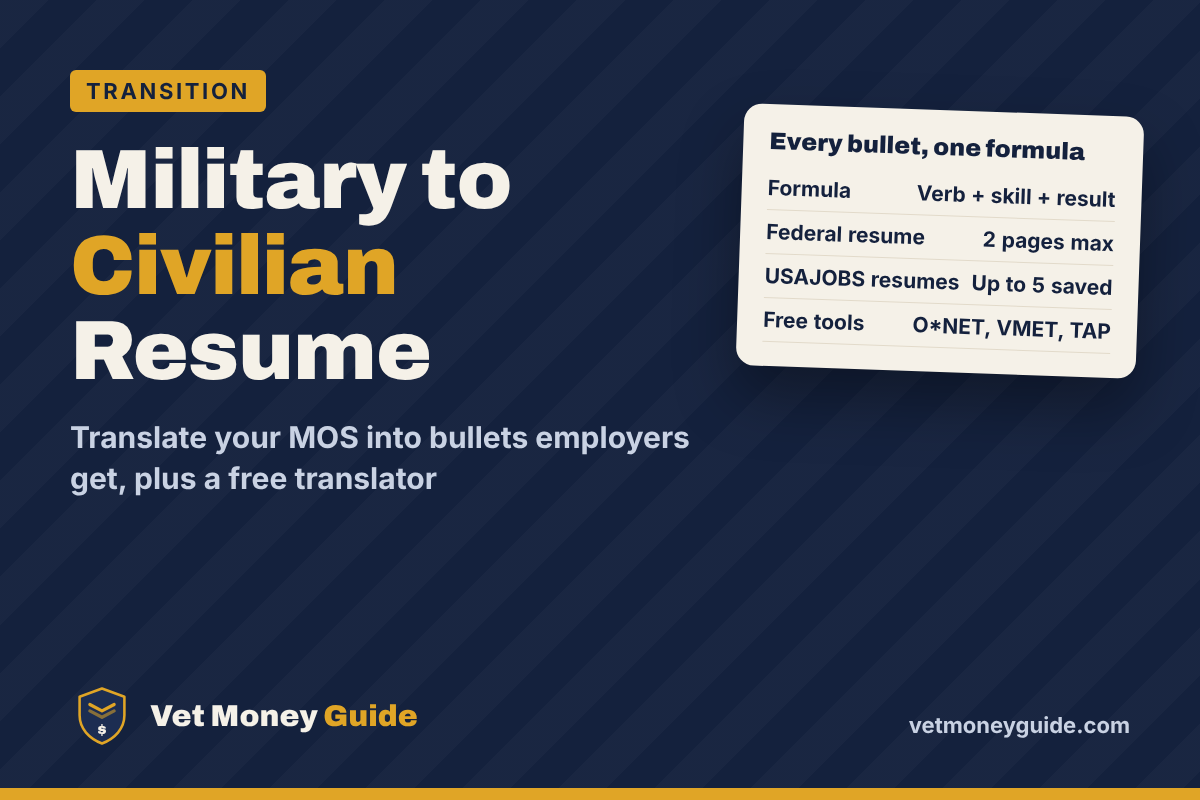
For a private-sector job, one or two pages is the usual target. For a federal job, it’s not a guideline: USAJOBS says agencies only accept resumes up to two pages under the Merit Hiring Plan, and the site won’t let you upload or build a longer one.
As an Army veteran who served from 2007 to 2017, I know evaluation-report language reads like a foreign language outside the gate. Below you’ll find a free bullet translator worksheet, before and after examples, a jargon table, the format that works, and the free official tools worth using first.
Quick answer
- Formula for every bullet: action verb + what you did in civilian words + scope (people, dollars, volume) + result.
- Federal resume: two pages max on USAJOBS. List month and year dates and hours per week for each job.
- USAJOBS bullet format: “Accomplished [X] as measured by [Y], by doing [Z].”
- Free tools first: the O*NET Military Crosswalk, your VMET (DD Form 2586), and TAP’s Department of Labor employment workshop.
- Never: rank as a job title, unit names a civilian can’t size, or acronyms without a translation.
In this guide
- Why military bullets don’t land with civilians
- How to translate your MOS, rank and duties
- Free military bullet translator worksheet
- Before and after: example bullets
- Military terms and civilian replacements
- Military to civilian resume template and format
- Federal vs private-sector resumes
- Free official tools to use first
- Common mistakes to fix before you apply
- FAQ
Why military bullets don’t land with civilians
Evaluation bullets are written for a board that already speaks the language. A board member knows what an NCOIC does, how big a platoon is, and why a clean CMDP inspection matters. A recruiter at a logistics company doesn’t, and they may give your resume a short first look.
Civilian readers want to know three things fast: what you did, how big it was, and what changed because of you. Your military record usually has all three. They’re just buried under acronyms, unit names and rank.
The fix isn’t to hide your service. It’s to translate it. Keep the substance, change the words, and add the numbers a civilian needs to picture the size of the job.
How to translate your MOS, rank and duties
Step 1: Look up your MOS in the O*NET Military Crosswalk
The Department of Labor’s O*NET OnLine has a free Military Crosswalk Search. You pick your branch (Army MOS, Air Force AFSC, Navy or Coast Guard rating, Marine Corps MOS, Space Force SFSC), type your code or title, and it shows civilian occupations that match. Use those occupation names and their task lists as a vocabulary source for your bullets.
Step 2: Pull your VMET and your transcript
Your Verification of Military Experience and Training (VMET, DD Form 2586) lists your military experience and training with civilian-equivalent descriptions. You download it from milConnect under the DoD Transition Assistance Program section. If your branch uses the Joint Services Transcript (JST), pull that too: it pairs your military education and training with college credit recommendations from the American Council on Education.
Step 3: Replace rank with a job title that fits your duties
“Staff Sergeant” tells a civilian nothing. “Logistics Supervisor” does. Choose the title from what you actually did and how many people you led, not from your pay grade. Then check it against real job postings for the work you want.
| If your job was mostly… | Civilian titles to consider |
|---|---|
| Leading a small team (squad, section, work center) | Team Lead, Shift Supervisor, Crew Supervisor |
| Leading several teams (platoon, division afloat, flight) | Operations Supervisor, Section Manager |
| Running a whole unit’s people and equipment | Operations Manager, General Manager |
| Planning and scheduling on a staff (S-3, G-3) | Operations Planner, Program Analyst |
| Supply, property and inventory (S-4, supply room) | Supply Chain Specialist, Inventory Control Supervisor |
| Vehicle or equipment maintenance | Fleet Maintenance Supervisor, Maintenance Technician |
| Personnel actions and records (S-1) | HR Specialist, Personnel Administrator |
| Networks, radios and help desk (S-6) | IT Specialist, Network Technician |
Step 4: Rewrite each duty as a result
Every bullet gets the same shape: action verb, what you did in civilian words, how big it was, and what changed. If you can’t find a result, ask the questions in the worksheet below. Most of us did more measurable work than our old bullets show.
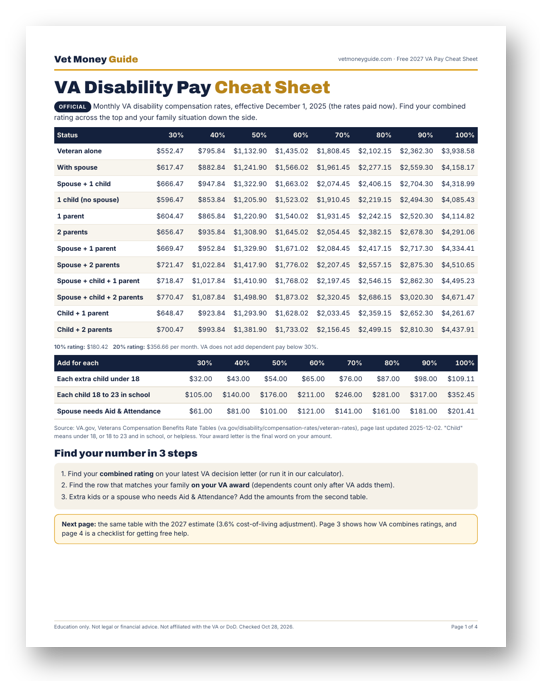
Free: the 2027 VA Pay Cheat Sheet
Every VA disability rate on one page, the 2027 estimate with the 3.6% COLA, the combined rating math, and a checklist for free VSO help. 4 printable pages.
Free military bullet translator worksheet
Paste one bullet from an NCOER, OER, EPR, FITREP, award write-up or your current resume. The worksheet flags military terms and unknown acronyms, swaps the common ones for civilian wording, suggests action verbs for the kind of work you did, and walks you through scope and result. Switch to “Federal resume” to see the same bullet in the USAJOBS format. Nothing you type is sent anywhere.
Military Bullet Translator Worksheet
Paste one bullet from an evaluation, award write-up or old resume. You get the military terms to replace, a civilian draft, and a builder that turns it into action verb + civilian skill + measurable result. Free. Nothing you type leaves this page.
This is a writing aid, not a guarantee of any job result. Use only true numbers you can explain in an interview. Last checked October 28, 2026.
Tip: Run your five strongest bullets first. A hiring manager reads the top of the page most closely, so your best translated results belong under your most recent job.
Before and after: example bullets
These are examples written for this guide, not real service records. The numbers are made up to show the shape. Use your own true numbers, the ones you could explain in an interview.
| Before (military bullet) | After (civilian bullet) |
|---|---|
| NCOIC of S-4 section; maintained 100% accountability of property book | Supervised a 6-person logistics team and managed a 450-item equipment inventory worth $2.1M with zero losses across 2 compliance inspections |
| Responsible for PMCS on 22 HMMWVs; reduced deadlined vehicles | Led preventive maintenance for a 22-vehicle fleet, cutting vehicles out of service from 5 to 1 in 3 months |
| Trained 40 NCOs on OPORD writing and AARs | Designed and taught a 2-day course that trained 40 supervisors to write operations plans and run lessons-learned reviews |
| Processed NCOERs, awards and personnel actions for the battalion | Processed 300+ performance evaluations, awards and personnel actions a year for a 600-employee organization with no late submissions |
| Maintained SIPR/NIPR and COMSEC for brigade TOC | Administered secure and unclassified networks and encryption equipment for a 24-hour operations center serving 150 users |
| Platoon medic; treated Soldiers in garrison and downrange | Provided routine and emergency care for a 35-person team in the U.S. and overseas; trained all 35 in first aid |
Notice what changed. The acronyms are gone. “Platoon” became “35-person team.” “Accountability” became a dollar value and a count. And each bullet ends with something that improved or was proven, not just a duty.
Military terms and civilian replacements
The worksheet checks for many of these automatically. Here are the ones that show up most in transition resumes.
| Military term | Civilian wording |
|---|---|
| NCOIC, NCO | Supervisor, team lead |
| OIC | Manager, project lead |
| Soldiers, Marines, Sailors, Airmen | Team members, employees, staff |
| Squad, platoon, company, battalion | Team of [number] people, department, organization |
| S-1 / S-2 / S-3 / S-4 / S-6 | HR / security / operations / logistics / IT |
| Mission | Project, operation, objective |
| OPORD, CONOP | Operations plan, project plan |
| AAR | Lessons-learned review |
| Property book, hand receipt | Asset inventory, equipment accountability records |
| PMCS, deadlined | Preventive maintenance, out of service |
| NCOER, OER, EPR, FITREP | Performance evaluations |
| Counseling | Coaching, performance reviews |
| TDY, PCS | Business travel, relocation |
| BLC, ALC, SLC, BOLC | Leadership course (list under Training) |
| CMDP, IG inspection | Compliance inspection, internal audit |
Military to civilian resume template and format
Most transitioning service members do well with a reverse-chronological resume: most recent job first. If you’re changing fields completely, a short skills section near the top helps the reader connect your experience to the new work. Use this outline as your template.
- Contact line: name, city and state, phone, email, and a LinkedIn link if you keep it current.
- Headline: the job you want, in the posting’s words. Example: “Logistics Supervisor | Inventory Control | Team Leadership.”
- Summary: two or three lines. Years of experience, your core skills, and the kind of role you’re after.
- Skills: six to ten hard skills that appear in the postings and that you can prove in a bullet below.
- Experience: each assignment as a job: civilian title, “U.S. Army” (or your branch), location, month and year dates, then three to six translated bullets.
- Education and training: degrees, then the military courses that matter for this job, described in plain words.
- Certifications and clearance: civilian certifications, plus your clearance level and status if the job asks for one.
Keep the layout plain: one column, standard fonts, normal section headings, no tables or graphics holding key text. Many employers run resumes through software before a person reads them, and simple layouts are the safest bet. Save a PDF for email and keep an editable copy for every new posting.
Tip: Awards go in one short line or section, translated. “Army Commendation Medal for leading a 450-item inventory turnover with zero losses” tells a civilian far more than “ARCOM.”
Want help with layout or a second set of eyes?
Start free: your installation’s transition center and TAP counselors can review a draft, and the USAJOBS resume builder handles the federal format. If you choose a resume builder or a professional writer later, keep an editable copy, check that the file stays simple, and make sure every line is still something you can explain in an interview.
Federal vs private-sector resumes
Many veterans apply to both. They aren’t the same document. USAJOBS publishes specific rules for federal resumes, while private employers set their own expectations.
| Item | Federal (USAJOBS) | Private sector |
|---|---|---|
| Length | Two pages max. USAJOBS won’t let you upload or build a longer resume. | No fixed rule. One or two pages is the usual target. |
| Dates | Start and end dates with month and year for each job | Month and year is common; year only is accepted by many employers |
| Hours per week | Required for each job | Not expected |
| Series and grade | Required for federal civilian jobs you’ve held | Not used |
| Bullet style | Suggested: “Accomplished [X] as measured by [Y], by doing [Z]” | Action verb + scope + result |
| Tailoring | Address every required qualification in the announcement, using similar terms | Mirror the posting’s key skills where true |
| File | Up to five resumes in your profile; 5MB max; PDF recommended | Whatever the application asks for, usually PDF or Word |
Before you write a federal resume, read the announcement’s Duties, Requirements and “How You Will Be Evaluated” sections. USAJOBS says to tailor the resume to each job and to make sure your work experience addresses the requirements and qualifications listed there. If you claim veterans’ preference, the announcement’s required documents section tells you what to upload.
Watch out: Older advice says a federal resume should be long and detailed. That changed. USAJOBS now flags resumes in your profile that are too long, so update them before you apply.
Free official tools to use first
- O*NET Military Crosswalk Search (Department of Labor): branch plus MOS, AFSC or rating in, matching civilian occupations out.
- Transition Assistance Program (TAP): mandatory for separating service members with 180 continuous days or more on active duty. Military OneSource says to complete it no later than a year before you leave, and retirees should begin at least two years out. It includes the Department of Labor’s Employment Fundamentals of Career Transition course, and you can elect the DOL Employment Workshop track.
- DOL Employment Workshop materials: the participant guide, presentation and resource guide are posted free on dol.gov, along with short videos on resumes and federal hiring.
- VMET (DD Form 2586) on milConnect: your training and experience with civilian-equivalent descriptions.
- USAJOBS resume builder: starts from your profile and walks you through each field in the federal format.
Separating soon? Your resume isn’t the only paperwork with a deadline. If you have service-connected conditions, see what a VA rating could mean in dollars and talk to a free VA-accredited VSO about your claim.
Run your own numbers
See your combined VA rating and monthly pay, with dependents, using the official 2026 rates and the 2027 estimate.
Open the free VA disability calculatorCommon mistakes to fix before you apply
- Rank as a job title. Use a civilian title that matches your duties.
- “Responsible for” bullets. Start with what you did: led, managed, trained, cut, built.
- No numbers. People, dollars, items, hours, before and after. Pick one true number per bullet.
- Unit names. “3rd Battalion” means nothing to a civilian. “A 600-person organization” does.
- Every assignment, equal space. Give the most room to the jobs closest to the one you want.
- One resume for every job. Tailor the headline, skills and top bullets to each posting.
- Combat details a reader can’t use. Keep what shows skill, judgment and results. Leave out what doesn’t.
PCS Checklist: 90 Days Out to Move-In (Free Countdown Tool)
VA Disability Calculator 2027: Combined Rating + Dependents
VA Combined Rating Calculator: How VA Math Works
FAQ
Is there a free military to civilian resume translator?
Yes. The Department of Labor’s O*NET Military Crosswalk matches your MOS, AFSC or rating to civilian occupations, which gives you the job titles and task language. The worksheet on this page works at the bullet level: it flags military terms, swaps common ones, and builds each line as verb + skill + result. Neither one replaces your judgment, so read every line as a civilian would.
How long should a military to civilian resume be?
For federal jobs, two pages is the limit: USAJOBS says agencies only accept resumes up to two pages, and the site blocks longer ones. For private-sector jobs there’s no fixed rule, but one or two pages is the usual target. If you’re over, cut older and unrelated assignments first.
Is there a free military to civilian resume builder?
For federal jobs, USAJOBS has a free resume builder that starts with your profile, and you can keep up to five resumes there. For private-sector jobs, any plain word processor works if you follow the template above. Your TAP counselors and installation transition center can also review drafts at no cost.
Should I pay for military resume writing services?
Try the free help first: TAP, the DOL Employment Workshop materials and your transition center. If you still want a paid writer, ask to see sample work, make sure you get an editable file, and confirm you can explain every number they write. You’ll be asked about each bullet in interviews.
Where can I get a military to civilian resume template?
Use the seven-part outline in the template section above: contact line, headline, summary, skills, experience, education and training, then certifications and clearance. Build it in a simple one-column document. For each job, write three to six bullets with the worksheet, and put your strongest result first.
Should I put my security clearance on my resume?
If the job asks for one, list the clearance level and whether it’s active, in one line under certifications. Never include classified details, program names or anything you couldn’t say in an unclassified interview. Your duties can still be described in general civilian terms.

Sources (checked October 28, 2026)
- USAJOBS Help Center, Resume page limit (two pages, Merit Hiring Plan)
- USAJOBS Help Center, What to include in your resume
- USAJOBS Help Center, Upload or build a resume
- O*NET OnLine, Military Crosswalk Search (U.S. Department of Labor)
- Military OneSource, Transition Assistance Program
- DoD Transition Assistance Program (DoDTAP)
- U.S. Department of Labor, Employment Workshop (DOLEW) materials
- MCCS Twentynine Palms, How to pull your VMET (DD Form 2586)
- New York DMNA, Joint Services Transcript
- VA, Find a VA-accredited representative