CRSC Calculator 2027: CRSC vs CRDP Side by Side (Free)
Education only, not legal or financial advice. Not affiliated with the VA or DoD. Numbers checked against official sources on October 28, 2026. Disclosures.
This free CRSC calculator puts Combat-Related Special Compensation and Concurrent Retirement and Disability Pay side by side, using your own retired pay, VA ratings and dependents. Tick which ratings are combat-related, and it does the VA math on just those, applies every cap in the law, and shows your monthly and yearly total under each program.
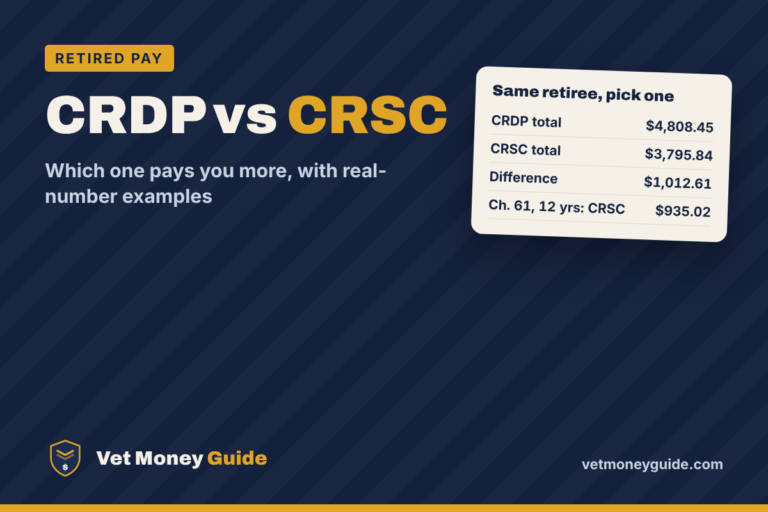
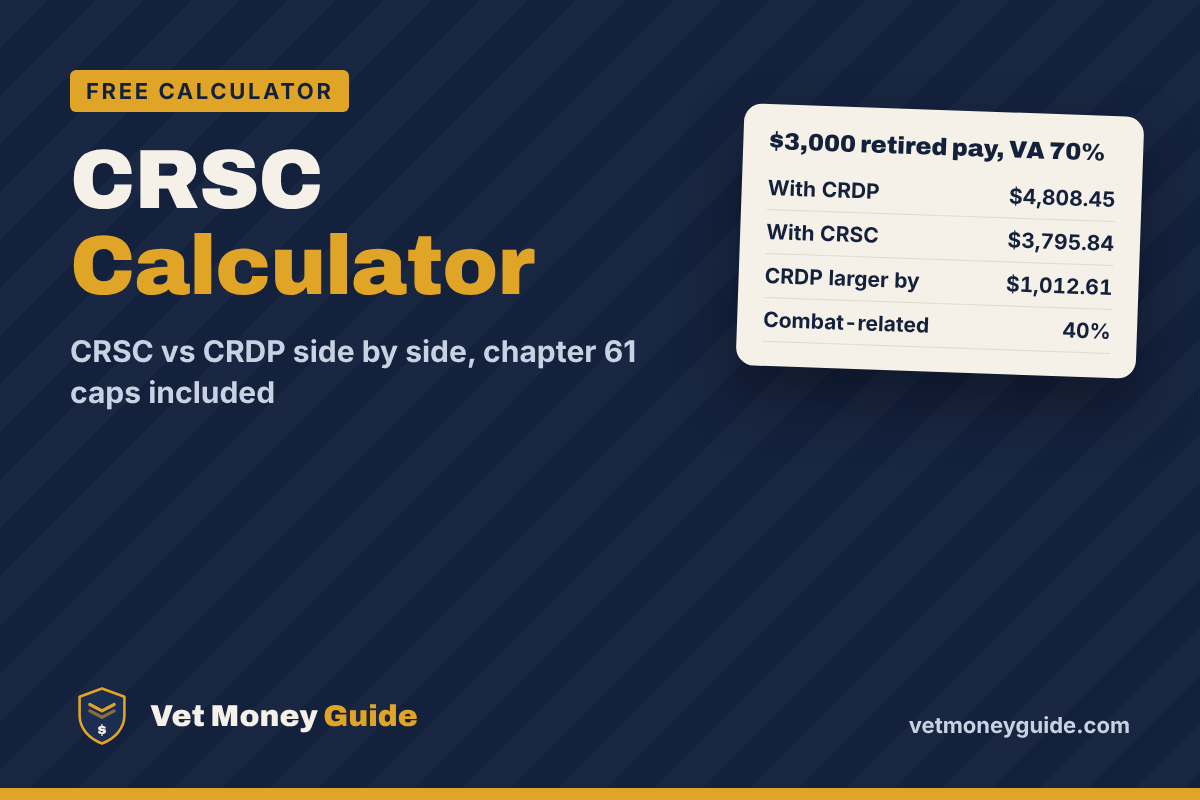
Here is a real-number example. A 20-year retiree with $3,000 of gross retired pay, rated 70% by VA, with combat-related ratings that combine to 40%, gets $4,808.45 a month with CRDP or $3,795.84 a month with CRSC. CRDP is larger by $1,012.61 a month in this example. Rated under 50%, or medically retired with under 20 years? Then CRSC may be the only way to get your waived retired pay back.
As an Army veteran, I built this because a good free CRSC calculator was hard to find. It shows VA’s official rates now, with a toggle for a clearly marked 2027 estimate. Nothing you type is stored or sent.
Quick answer
- CRSC pays the VA rate for your combat-related ratings only (with dependents), capped at the VA waiver taken from your retired pay.
- CRDP pays back the whole waiver, but only at a VA rating of 50% or higher.
- Example: $3,000 retired pay, VA 70%, combat-related 40%: $4,808.45 with CRDP vs $3,795.84 with CRSC.
- Rated 40%, all combat-related: CRSC adds $795.84 a month ($9,550.08 a year). CRDP pays nothing below 50%.
- You get one, never both. Open season to switch is normally January 1 to 31.
CRSC vs CRDP Calculator
Compare Combat-Related Special Compensation (CRSC) with Concurrent Retirement and Disability Pay (CRDP), side by side. Shows VA’s official rates now, or a 2027 estimate. Rules and rates checked October 28, 2026. Example values are filled in: replace them with yours.
Limits: what this calculator does not do
- It does not decide eligibility. Only your branch decides which disabilities are combat-related, and only DFAS computes your payment. Use your DFAS open season letter for the official numbers.
- Not modeled: CRSC effective dates and retro pay; TDRL; special monthly compensation; SBP and other deductions; reserve retirement timing beyond “drawing retired pay or not”; how DFAS handles REDUX or BRS for chapter 61 CRDP beyond the standard multiplier.
- Chapter 61 limits are computed from the base you enter. DFAS raises the chapter 61 reduction with each COLA since you retired (FMR 7B, ch. 63, para 8.5.3), so if you retired years ago, DFAS’s figures can differ.
- TDIU: the box above pays VA at the 100% rate for the waiver and CRDP. How TDIU affects CRSC is not modeled; ask your branch CRSC office.
- 2027 view: retired pay x 1.036 (REDUX 1.026), rounded down to the dollar, and our 2027 VA estimate. Both are estimates until DFAS and VA publish.
- Children: if all your children are 18 to 23 and in school, one is counted in the base rate. Confirm with VA.
- Privacy: everything runs in your browser. Nothing you enter is stored or sent.
Sources: 10 U.S.C. 1413a · 10 U.S.C. 1414 · 10 U.S.C. 1401 · DoD FMR 7B ch. 63 · DFAS CRSC · DFAS CRDP · VA rates · 38 CFR 4.25
Education only. Not legal or financial advice. Not affiliated with VA, DoD or DFAS. For help, use free options: a VA-accredited VSO (find one on VA.gov) or your branch’s CRSC office. You never need to pay anyone to apply for CRSC.
How to fill in each field
Have three documents handy: your DFAS retiree account statement, your latest VA decision letter, and, if you have one, your branch’s CRSC decision letter. The calculator opens with an example filled in. Replace it with your numbers.
Rates: Now (official) or 2027 (estimate)
“Now” uses VA’s official table effective December 1, 2025 and the retired pay you enter. “2027” raises your retired pay by the 3.6% COLA (2.6% under REDUX), rounded down to the whole dollar as 10 U.S.C. 1412 requires, and uses our 2027 VA estimate. The 2027 view is dashed and amber and every card says ESTIMATE, because VA’s 2027 raise still needs Congress to pass the COLA Act and VA hasn’t published its table.
Retirement type
- Longevity (20+ years): a regular active duty retirement.
- Chapter 61 medical retirement: you were retired for disability. This opens two more fields, covered below.
- TERA: an early retirement. It is not a chapter 61 retirement, so the standard rules apply.
- Guard or Reserve, drawing retired pay: treated like a regular retiree.
- Guard or Reserve, not yet drawing: neither program pays yet. With no retired pay, there is no waiver to give back. Reserve retired pay generally starts at age 60.
Gross monthly retired pay: where to find it
Use the gross retired pay on your DFAS retiree account statement, which you can pull from myPay. That is the amount before any deductions and before the VA waiver comes out. Don’t use your net deposit. If your statement already shows a VA waiver, use the gross figure above it. Commas and dollar signs are fine; the calculator ignores them.
Tip: chapter 61 retiree and don’t know your gross? Leave it blank and fill in your retired pay base and DoD disability rating. The calculator estimates gross retired pay with the formula in 10 U.S.C. 1401: base times the larger of your DoD rating or 2.5% per year of service, never more than 75%.
Years of service and retirement system (chapter 61 years matter most)
Enter your years of creditable service as shown on your retirement orders or DFAS paperwork. For longevity retirees it doesn’t change the result. For chapter 61 retirees it decides almost everything:
- Under 20 years: no CRDP at all (10 U.S.C. 1414(b)(2)). CRSC is still possible, but CRSC plus the retired pay you still receive can’t exceed base x 2.5% x years (2.0% under BRS).
- 20 years or more: both programs restore retired pay only up to what a longevity retirement would have paid. Anything above that stays waived.
Pick your retirement system (High-3, Final Pay, REDUX or BRS). It sets the 2.5% or 2.0% per year used in those chapter 61 limits. The retired pay base is your High-3 average (or final basic pay under Final Pay). The DoD disability rating is the percentage on your retirement orders, not your VA rating.
Your VA ratings, and which ones are combat-related
Enter every separate rating from your VA decision letter. The calculator runs VA math on all of them for your VA pay and CRDP. Then tick combat-related on each rating your branch approved for CRSC, or that you expect it to approve. The calculator runs VA math again on only those ticked ratings, and that rating sets your CRSC.
Under 10 U.S.C. 1413a(e), a combat-related disability is one that:
- came from an injury that earned a Purple Heart, or
- was incurred as a direct result of armed conflict,
- while engaged in hazardous service,
- in the performance of duty under conditions simulating war, or
- through an instrumentality of war.
Watch out: only your branch decides which disabilities are combat-related. Ticking a box here is a what-if, not a decision. If you have a branch CRSC letter, use the shortcut “I already know my CRSC rating” and pick the rating it shows.
Tick paired limb only for an arm or leg rating when the matching limb on the other side is also rated. The bilateral factor from 38 CFR 4.26 is applied separately to the full list and to the combat-related list. There is also a shortcut for your VA combined rating, and a box for veterans VA pays at the 100% rate through individual unemployability (TDIU).
Dependents
Enter the dependents VA has on your award: spouse, spouse Aid and Attendance, children under 18, children 18 to 23 in school, and dependent parents. DoD’s financial regulation (Vol. 7B, ch. 63, para 8.1.1) says CRSC uses the same dependency rates VA uses, so your dependents count on both sides. VA adds dependent pay only at 30% or higher.
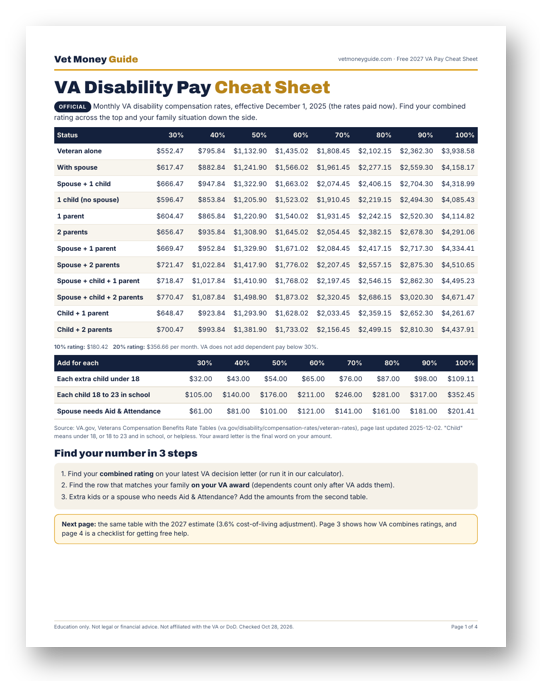
Free: the 2027 VA Pay Cheat Sheet
Every VA disability rate on one page, the 2027 estimate with the 3.6% COLA, the combined rating math, and a checklist for free VSO help. 4 printable pages.
What your result means
Hit Calculate and you get, from top to bottom:
- One plain sentence, such as “CRDP is larger by $1,012.61 a month ($12,151.32 a year) in this example.” It never tells you which to pick. It reports which number is bigger.
- Two cards, CRDP and CRSC. Each shows Eligible or Not eligible with the reason, the program’s monthly amount, and your total monthly income: DFAS retired pay after the waiver, plus VA pay, plus that program.
- The difference per month and per year.
- A line-by-line table: gross retired pay, VA pay, the waiver (the smaller of the two), retired pay after the waiver, and the totals with neither, with CRDP and with CRSC.
- The VA math, step by step, for all your ratings and for the combat-related ratings only. Chapter 61 retirees also get the cap math.
- An open season reminder and a Print my worksheet button. The worksheet fills a two-page CRSC vs CRDP worksheet with your numbers, plus a checklist and branch CRSC addresses for page two. Take it to your VSO.
Why is CRSC usually the smaller number when you qualify for both? CRDP gives back the whole waiver. CRSC pays only the VA amount for your combat-related ratings, and it can never be more than the waiver. So when you qualify for both, CRSC can match CRDP but can’t beat it in this math. They tie when all of your rated disabilities are combat-related. Where CRSC really matters is when CRDP isn’t available at all.
Four worked examples
All four use VA’s official rates effective December 1, 2025. Retired pay amounts are examples. These are the same test cases the calculator must pass before every update.
Example 1: 20-year retiree, CRDP is larger
$3,000 gross retired pay. VA ratings 50% and 40% (combined 70%, veteran alone). Only the 40% is combat-related.
VA math: 50, then 40% of the remaining 50 = 20. 50 + 20 = 70, so 70%: $1,808.45 a month.
Waiver: $1,808.45. Retired pay after waiver: $3,000.00 minus $1,808.45 = $1,191.55.
CRDP restores the whole waiver: $1,808.45. Total = $1,191.55 + $1,808.45 + $1,808.45 = $4,808.45.
CRSC at the 40% rate: $795.84. Total = $1,191.55 + $1,808.45 + $795.84 = $3,795.84.
CRDP is larger by $1,012.61 a month ($12,151.32 a year) in this example.
With the 2027 toggle, retired pay becomes $3,108 and the totals become about $4,981.55 with CRDP and about $3,932.49 with CRSC (estimates). The gap grows to about $1,049.06 a month.
Example 2: rated 40%, CRSC is the only way back
$2,500 gross retired pay. VA 40%, combat-related.
VA 40% alone: $795.84. Waiver: $795.84. Retired pay after waiver: $1,704.16. Total with neither: $2,500.00.
CRDP: not eligible, because the rating is under 50%.
CRSC: $795.84 (the 40% rate, equal to the waiver). Total = $1,704.16 + $795.84 + $795.84 = $3,295.84.
Only CRSC applies. It adds $795.84 a month ($9,550.08 a year).
Example 3: chapter 61, 12 years (CRSC calculator for chapter 61 retirees)
Chapter 61 medical retirement. 12 years. Retired pay base $5,000. DoD rating 40%. VA 60%, all combat-related.
Gross retired pay: $5,000 x the larger of 40% (DoD) or 2.5% x 12 = 30%. So 40%: $2,000.00.
VA 60% alone: $1,435.02. Waiver: $1,435.02. Retired pay after waiver: $564.98.
CRDP: not eligible (chapter 61 with under 20 years).
CRSC before the cap: $1,435.02. Cap: CRSC plus remaining retired pay can’t exceed $5,000 x 2.5% x 12 = $1,500.00.
CRSC = $1,500.00 minus $564.98 = $935.02.
Total = $564.98 + $1,435.02 + $935.02 = $2,935.02, up from $2,000.00 with neither.
In the 2027 view this becomes about $968.68 of CRSC and a total of about $3,040.68 (estimates). The calculator raises the cap by the same COLA, because DoD’s regulation (para 8.5.3) increases the chapter 61 reduction with each retired pay COLA.
Example 4: 22-year retiree with a spouse
$2,200 gross retired pay. 22 years. VA ratings 50, 30, 20 and 10 with a spouse. Combat-related: the 50 and the 10.
All ratings: 50, then 30% of 50 = 15 (65), then 20% of 35 = 7 (72), then 10% of 28 = 2.8 (74.8, kept as 75). 75 rounds to 80%: $2,277.15 with a spouse.
Combat-related only: 50, then 10% of 50 = 5. 55 rounds to 60%: $1,566.02 with a spouse.
Waiver: the whole $2,200.00, since VA pay is larger. Retired pay after waiver: $0.00.
CRDP: $2,200.00. Total = $0 + $2,277.15 + $2,200.00 = $4,477.15.
CRSC: $1,566.02. Total = $0 + $2,277.15 + $1,566.02 = $3,843.17.
CRDP is larger by $633.98 a month ($7,607.76 a year) in this example.
Notice the combat-related ratings went through their own VA math. You can’t take 80% and subtract the non-combat ratings. DoD’s own example (FMR Vol. 7B, ch. 63, para 9.2) does it the same way: combat-related ratings of 40% and 30% combine to 58, which becomes a 60% CRSC rating.
CRSC pay by combat-related rating
Gross CRSC is the VA rate for your combat-related rating, so this chart is the VA table read a different way. Your actual CRSC is the smaller of this amount and your VA waiver, and chapter 61 retirees can get less because of the caps above.
| Combat-related rating | Veteran alone, now | Veteran alone, 2027 (estimate) | With spouse, now | With spouse, 2027 (estimate) |
|---|---|---|---|---|
| 10% | $180.42 | $186.92 | $180.42 | $186.92 |
| 20% | $356.66 | $369.50 | $356.66 | $369.50 |
| 30% | $552.47 | $572.36 | $617.47 | $640.36 |
| 40% | $795.84 | $824.49 | $882.84 | $914.49 |
| 50% | $1,132.90 | $1,173.68 | $1,241.90 | $1,286.68 |
| 60% | $1,435.02 | $1,486.68 | $1,566.02 | $1,622.68 |
| 70% | $1,808.45 | $1,873.55 | $1,961.45 | $2,032.55 |
| 80% | $2,102.15 | $2,177.83 | $2,277.15 | $2,358.83 |
| 90% | $2,362.30 | $2,447.34 | $2,559.30 | $2,651.34 |
| 100% | $3,938.58 | $4,080.37 | $4,158.17 | $4,307.86 |
For children and dependent parents, use the calculator or the full VA disability pay chart 2027.
Limits of this calculator
It’s a planning tool. Your DFAS open season letter and your branch’s CRSC decision are the official word. What it leaves out:
- Eligibility decisions. Your branch decides what is combat-related. DFAS computes the payment.
- CRSC effective dates and back pay. It shows monthly amounts only.
- TDRL, special monthly compensation, SBP and other deductions.
- Reserve timing beyond “drawing retired pay or not.”
- Chapter 61 COLAs since retirement. The caps are computed from the base you enter. DFAS raises the chapter 61 reduction with each COLA since you retired, so if you retired years ago, its numbers can differ. REDUX and BRS are handled only through the standard multiplier.
- TDIU and CRSC. The TDIU box pays VA at the 100% rate for the waiver and CRDP. Its effect on CRSC is not modeled, so ask your branch CRSC office.
- 2027 numbers are estimates until DFAS and VA publish them.
How to apply for CRSC
CRDP is usually automatic. DFAS says it can start CRDP without a written claim, and if you qualify but aren’t being paid, you send a DD Form 827. CRSC is different: you must apply, and you apply to your branch of service, not to VA or DFAS.
- Get DD Form 2860, “Claim for Combat-Related Special Compensation (CRSC).” The current edition on the DoD forms site is dated 07/01/2011. First-time applicants use this form. If you already have CRSC and VA adds a new disability, DFAS says to ask your branch for a reconsideration application instead.
- Gather copies, not originals. DFAS lists retirement orders, a 20-year letter or statement of service (reservists), VA rating decisions, the relevant VA or service medical records, Purple Heart citations, and your DD-214. Originals aren’t returned, and DFAS notes that quality matters more than quantity.
- Send it to your branch (contacts below, from DFAS’s “Apply for CRSC” page).
- Wait for the written decision. If approved, the branch sends the approval to DFAS, and DFAS pays CRSC as its own monthly payment.
| Branch | Where to send it | Phone / online |
|---|---|---|
| Army | U.S. Army Human Resources Command, ATTN: CRSC Division, 1600 Spearhead Division Avenue, Fort Knox, KY 40122 | 866-281-3254, crsc.info@us.army.mil |
| Navy and Marine Corps | Secretary of the Navy Council of Review Boards, Combat Related Special Compensation, 720 Kennon Street SE, Suite 309, Washington Navy Yard, DC 20374-5023 | 877-366-2772, CRSC@navy.mil |
| Air Force and Space Force | 550 C St West, JBSA Randolph, TX 78150 | Apply online through MyPERS |
| Coast Guard | Not listed on DFAS’s page | Contact the Coast Guard’s CRSC office |
Tip: you don’t need to pay anyone to apply. A VA-accredited VSO helps for free, and your branch’s CRSC office answers questions directly. Find a free accredited VSO on VA.gov.
Open season: when you can switch
If you qualify for both programs, DFAS pays one and lets you switch once a year. DoD’s financial regulation (Vol. 7B, ch. 63, para 3.2) says open season is normally January 1 to 31, that you get one chance a year to change, that your current election continues if you make no request, and that the member bears the responsibility for the choice.
The last one ran January 1 to 31, 2026, and change requests had to be postmarked by January 31, 2026. DFAS mails an open season letter that shows your options. Per DFAS’s FAQ, check the box only if you want to change. A form returned with a signature and no checkmark is unclear, so no action is taken.
Watch out: once open season closes, you can’t switch until the next one. Run your numbers through the calculator in December, compare them with the DFAS letter, and mail any change early.
Want the full side-by-side explanation of both programs? Read the companion guide below.
CRDP vs CRSC: Which One Pays You More (With Examples)
VA Disability Calculator 2027: Combined Rating + Dependents
VA Combined Rating Calculator: How VA Math Works
VA Disability Pay Chart 2027: Every Rating, With Spouse and Children
FAQ
How is CRSC calculated?
Combine only your combat-related ratings with VA math, look up the VA rate for that rating with your dependents, and cap it at the VA waiver taken from your retired pay. Combat-related ratings of 50% and 10% combine to 55, which becomes 60%: $1,566.02 a month with a spouse at current rates. Chapter 61 retirees have an extra cap.
Is there a CRSC calculator for chapter 61 retirees?
Yes, this one. Pick “Chapter 61 medical retirement” and enter your base and years. Under 20 years, CRSC plus remaining retired pay is capped at base x 2.5% x years (2.0% under BRS). In Example 3, that cap turns $1,435.02 of gross CRSC into $935.02.
Can you get CRSC and CRDP at the same time?
No. 10 U.S.C. 1414(d) says a retiree who qualifies for both gets one or the other, not both. You can switch during the annual open season, normally January 1 to 31.
Do I qualify for CRSC?
DFAS lists four requirements: you are entitled to or receiving military retired pay, VA rates you at least 10%, your VA pay is waived from your retired pay, and you file a CRSC application with your branch. Your disability also has to be combat-related under one of the five categories in 10 U.S.C. 1413a(e).
Does the CRSC calculator figure back pay?
No. It shows monthly amounts. DFAS says CRSC retro pay may go back as far as June 1, 2003 (January 1, 2008 for disability retirees with under 20 years), limited by your own dates. In June 2025 the Supreme Court held in Soto v. United States that the Barring Act’s six-year limit does not apply to CRSC claims. Ask your branch CRSC office or a free VSO about your case.
Is there a CRSC pay chart for 2027?
Gross CRSC follows the VA table, so the chart above is it. At a 60% combat-related rating, veteran alone, that’s $1,435.02 now and about $1,486.68 in 2027 (estimate). Your actual CRSC is never more than your waiver.

Sources (checked October 28, 2026)
- 10 U.S.C. 1413a, Combat-related special compensation (Cornell LII)
- 10 U.S.C. 1414, Concurrent receipt (CRDP) (Cornell LII)
- 10 U.S.C. 1401, Computation of retired pay (Cornell LII)
- 10 U.S.C. 1412, Rounding to the lower whole dollar (Cornell LII)
- DoD Financial Management Regulation, Vol. 7B, Ch. 63, CRSC (June 2024)
- DFAS, Combat-Related Special Compensation (page updated June 25, 2024)
- DFAS, Apply for CRSC (page updated June 25, 2024)
- DFAS, Concurrent Retirement and Disability Pay (page updated July 17, 2023)
- DFAS, Understanding the VA Waiver and Retired Pay/CRDP/CRSC (page updated June 25, 2024)
- DFAS, CRDP/CRSC Open Season FAQs (page updated December 18, 2025)
- DD Form 2860, Claim for Combat-Related Special Compensation (edition 07/01/2011)
- Soto v. United States, No. 24-320 (U.S. June 12, 2025)
- VA, Current Veterans disability compensation rates (effective December 1, 2025)
- 38 CFR 4.25, Combined ratings table (Cornell LII)
- 38 CFR 4.26, Bilateral factor (Cornell LII)
- SSA, 3.6% COLA for 2027 (October 14, 2026)
- S. 4487, Veterans’ Compensation Cost-of-Living Adjustment Act of 2026 (GovInfo)
- VA, Find a VA-accredited representative