CRDP vs CRSC: Which One Pays You More (With Examples)
Education only, not legal or financial advice. Not affiliated with the VA or DoD. Numbers checked against official sources on October 28, 2026. Disclosures.
CRDP vs CRSC is the choice military retirees face when VA pay cuts into their retired pay: both programs give some or all of that money back, and if you qualify for both, you receive one, never both. CRDP restores the whole VA waiver but needs a 50% VA rating. CRSC needs only 10%, but it pays only for combat-related disabilities, and you have to apply to your branch.
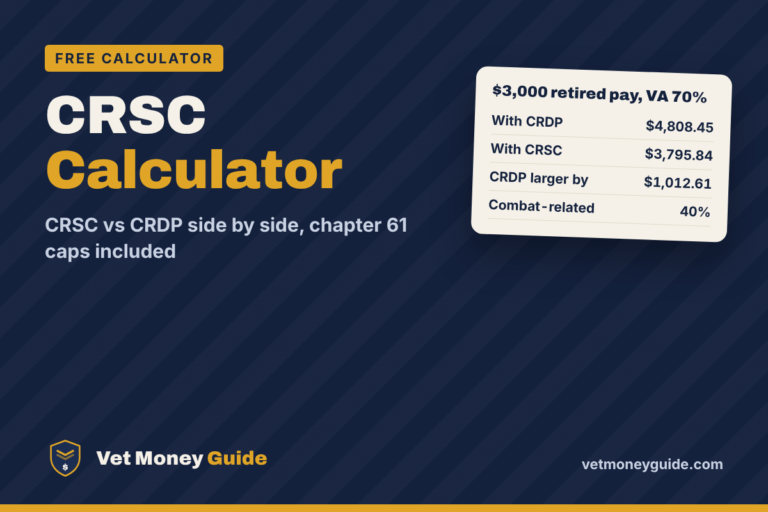
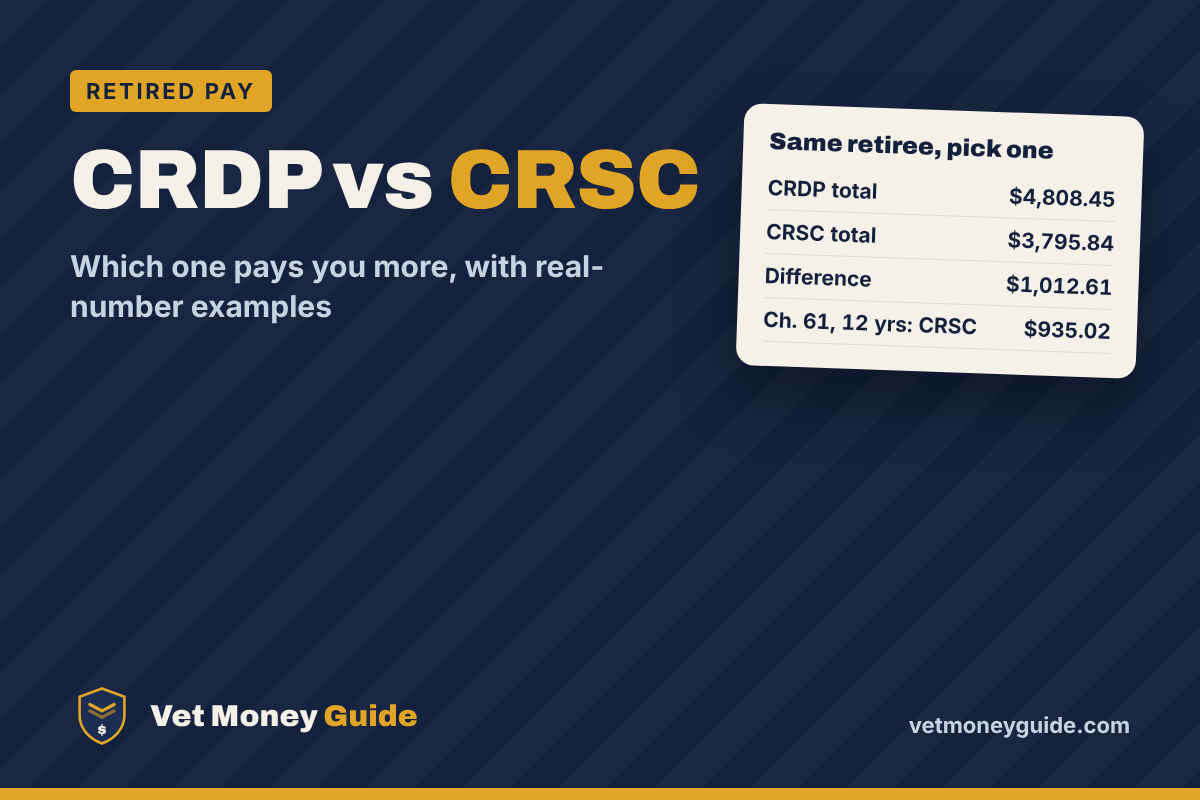
In dollars: a 20-year retiree with $3,000 of gross retired pay, rated 70%, with combat-related ratings that combine to 40%, gets $4,808.45 a month with CRDP or $3,795.84 with CRSC. CRDP is larger by $1,012.61 a month in this example. But a retiree rated 40% gets nothing from CRDP, and a medical retiree with under 20 years can’t get CRDP at all. For them, CRSC is the only way back.
Quick answer
- CRDP: VA rating 50%+, restores the full waiver, usually automatic.
- CRSC: VA rating 10%+, combat-related disabilities only, apply to your branch on DD Form 2860.
- Qualify for both? CRSC can tie CRDP but never beats it in the monthly math. They tie when all your rated disabilities are combat-related.
- Under 50%, or chapter 61 under 20 years? Only CRSC can help. Example: rated 40%, combat-related, CRSC adds $795.84 a month.
- Switching: open season is normally January 1 to 31. Do nothing and your current election continues.
The problem both programs fix: the VA waiver
DFAS says the law requires a military retiree to waive part of their gross retired pay, dollar for dollar, by the amount of their VA disability compensation. That’s the VA waiver, also called the VA offset.
$3,000 gross retired pay, VA 70% ($1,808.45)
Waiver: the smaller of $3,000.00 and $1,808.45 = $1,808.45.
DFAS now pays $3,000.00 minus $1,808.45 = $1,191.55. VA pays $1,808.45.
Total: $3,000.00. Same as before VA pay started. Only who pays it changed.
Without help, you gain nothing for your disability. CRDP and CRSC are the two programs that pay some or all of that waived amount back on top.
What CRDP is
CRDP, Concurrent Retirement and Disability Pay, comes from 10 U.S.C. 1414. If you’re entitled to retired pay and VA compensation in the same month, and VA rates you at least 50%, you’re paid both without the waiver. The phase-in ended December 31, 2013, so since January 1, 2014 CRDP restores the waiver in full.
You usually don’t apply. DFAS says it can start CRDP without a written claim. If you think you qualify and aren’t being paid, DFAS says to send DD Form 827. CRDP comes back as restored retired pay.
What CRSC is
CRSC, Combat-Related Special Compensation, comes from 10 U.S.C. 1413a. It pays a monthly amount for combat-related disabilities only. The law defines combat-related as a disability that came from a Purple Heart injury, or that was incurred as a direct result of armed conflict, while engaged in hazardous service, in the performance of duty under conditions simulating war, or through an instrumentality of war.
Your branch decides what qualifies, and you must apply to your branch on DD Form 2860. The law says CRSC payments are not retired pay (1413a(g)), and DFAS pays CRSC separately from your retired pay.
Eligibility side by side
| Rule | CRDP | CRSC |
|---|---|---|
| Minimum VA rating | 50% | 10% |
| Which disabilities count | All of them | Combat-related only |
| Must be drawing retired pay with a VA waiver | Yes | Yes |
| Chapter 61, under 20 years | Not eligible | Eligible, with a cap |
| Chapter 61, 20+ years | Eligible, limited to the longevity amount | Eligible, limited to the longevity amount |
| Guard and Reserve | Once retired pay starts (generally age 60) | Once retired pay starts (generally age 60) |
| How you get it | Usually automatic (DD Form 827 if not paid) | Apply to your branch (DD Form 2860) |
| Dependents count | Yes, through your VA pay | Yes, same VA dependency rates |
| Paid as | Restored retired pay | Separate payment, “not retired pay” |
| Both at once? | No. One or the other, chosen during open season | |
Five quick questions sort most people out. Are you drawing retired pay now? Is your VA rating 50% or higher? Were you medically retired under chapter 61 with under 20 years? Is any of your rating combat-related? If both programs are open to you, which one is bigger? The rest of this guide answers the last one.
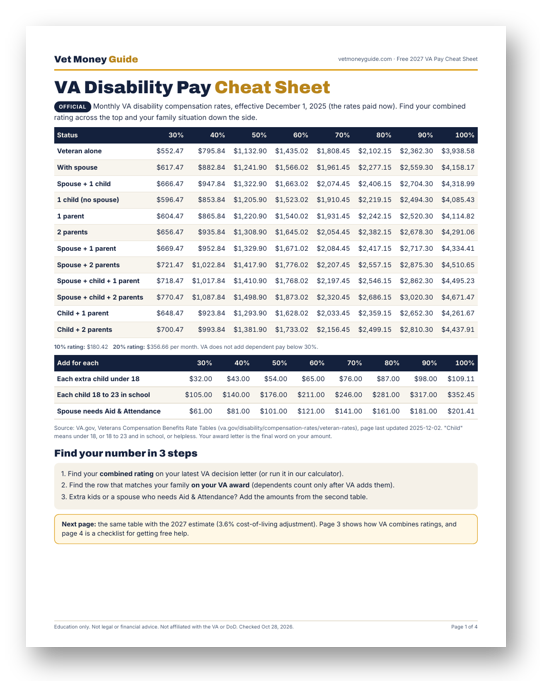
Free: the 2027 VA Pay Cheat Sheet
Every VA disability rate on one page, the 2027 estimate with the 3.6% COLA, the combined rating math, and a checklist for free VSO help. 4 printable pages.
How each one is calculated
CRDP
CRDP equals the waiver: the smaller of your gross retired pay and your VA pay. In the $3,000 example, that’s $1,808.45, for a total of $1,191.55 + $1,808.45 + $1,808.45 = $4,808.45 a month. Chapter 61 retirees with 20+ years get less in some cases (see the chapter 61 section).
CRSC
CRSC equals the VA rate for your combat-related ratings only, with your dependents, capped at the waiver. The key step is the VA math: your combat-related ratings are combined on their own, not carved out of your overall rating. DoD’s financial regulation shows it with this example (Vol. 7B, ch. 63, para 9.2):
Combat-related ratings: 40% and 30%
Start with 40. Remaining: 60.
30% of the remaining 60 = 18. 40 + 18 = 58.
58 rounds to 60%. CRSC is paid at the 60% rate: $1,435.02 a month for a veteran alone, $1,566.02 with a spouse (current rates), as long as at least that much was waived.
Dependents count: DoD’s regulation says DFAS uses the same dependency rates VA uses (para 8.1.1). And the cap is firm: CRSC “may not exceed” the reduction in your retired pay (1413a(b)(2), FMR para 8.2).
When each one comes out larger
Here’s the pattern. CRDP gives back the whole waiver. CRSC can never be more than the waiver. So when you qualify for both, CRDP is at least as large in the monthly math, and the two tie only when all your rated disabilities are combat-related. CRSC comes out ahead when CRDP isn’t available at all.
| Example | Total with CRDP | Total with CRSC | Result |
|---|---|---|---|
| 20 years, $3,000 retired pay, VA 70%, combat-related 40% | $4,808.45 | $3,795.84 | CRDP larger by $1,012.61 a month |
| Same, 2027 (estimate): retired pay $3,108 | $4,981.55 | $3,932.49 | CRDP larger by about $1,049.06 |
| 20 years, $3,000 retired pay, VA 70%, all combat-related | $4,808.45 | $4,808.45 | Equal amounts |
| 22 years, $2,200 retired pay, VA 80% with spouse, combat-related 60% | $4,477.15 | $3,843.17 | CRDP larger by $633.98 a month |
| 20 years, $2,500 retired pay, VA 40%, combat-related | $2,500.00 (not eligible) | $3,295.84 | Only CRSC applies: +$795.84 |
| Chapter 61, 12 years, base $5,000, DoD 40%, VA 60% combat-related | $2,000.00 (not eligible) | $2,935.02 | Only CRSC applies: +$935.02 |
The rated-under-50% case is the one people miss. With $2,500 of retired pay and a 40% rating, the waiver takes $795.84 and your total stays $2,500. CRDP can’t help. If that 40% is combat-related, CRSC pays the $795.84 back, and the total becomes $3,295.84 a month, or $9,550.08 more a year.
Tip: if the monthly amounts are equal, or close, don’t guess. There can be differences beyond the monthly math (for example, the law says CRSC payments are not retired pay, and CRSC retro pay follows its own rules). Ask DFAS or a free VA-accredited VSO before open season.
Run your own numbers
The free CRSC calculator does the VA math on your combat-related ratings, applies every cap, shows both totals side by side (now and a 2027 estimate) and prints a worksheet for your VSO.
Open the free CRSC calculatorChapter 61 (medical retirement) rules
Medical retirees under chapter 61 have special rules in both laws. Your years of creditable service decide which ones apply.
Under 20 years
No CRDP: 10 U.S.C. 1414(b)(2) says the concurrent payment rule doesn’t apply to chapter 61 retirees with less than 20 years. CRSC is still available, with a cap. CRSC plus the retired pay left after the VA waiver can’t exceed your retired pay base x 2.5% x your years of service (1413a(b)(3)(B)). DoD’s regulation uses 2% instead of 2.5% under the Blended Retirement System (FMR para 8.5.2.2).
12 years, base $5,000, DoD rating 40%, VA 60% (all combat-related)
Chapter 61 retired pay: $5,000 x the larger of 40% or 2.5% x 12 = 30%. So $2,000.00 (10 U.S.C. 1401).
VA 60%: $1,435.02. Waiver: $1,435.02. Retired pay left: $564.98.
Cap: $5,000 x 2.5% x 12 = $1,500.00. CRSC = $1,500.00 minus $564.98 = $935.02.
Total: $564.98 + $1,435.02 + $935.02 = $2,935.02, up from $2,000.00.
20 years or more
Both programs are open, but both stop at what a longevity retirement would have paid. For CRDP, DFAS says you receive concurrent pay only up to the amount you’d have received under a non-disability retirement, and the rest stays waived (1414(b)(1)). For CRSC, the law says CRSC plus remaining retired pay can’t exceed the retired pay you’d otherwise receive based on service (1413a(b)(3)(A), FMR para 8.5.2.1). This only bites when your DoD disability percentage is higher than your years multiplier.
One more detail: DoD’s regulation says the chapter 61 CRSC reduction rises with each retired pay COLA (para 8.5.3). The calculator applies that in its 2027 view.
CRSC back pay and the Supreme Court
On June 12, 2025, the Supreme Court decided Soto v. United States, No. 24-320, unanimously, in an opinion by Justice Thomas. The Court held that the CRSC statute gives its own settlement authority, so “the settlement procedures and limitations established under the Barring Act do not apply to claims for CRSC payments.” In plain terms, the Barring Act’s six-year limit doesn’t cut off CRSC claims.
DFAS’s CRSC page says retro pay may go back as far as June 1, 2003, limited by things like your CRSC start date, Purple Heart eligibility, retirement date and retirement law, and that disability retirees with under 20 years are limited to January 1, 2008. That DFAS page was last updated June 25, 2024, before the ruling, so ask your branch CRSC office how your claim is handled now. A free VSO can help you ask.
Watch out: you’ll also see headlines about the Major Richard Star Act, which would let combat-injured medical retirees with under 20 years receive both payments without the offset. Stars and Stripes reported on September 16, 2026 that a House discharge petition reached 218 signatures (a news report, not a primary source). It is not law as of October 28, 2026. The rules on this page are the rules until it passes.
Open season
If you qualify for both, 10 U.S.C. 1414(d) requires an annual election period. DoD’s regulation (para 3.2) spells out the rules:
- Open season is normally January 1 to 31.
- You get one chance a year to switch.
- If you make no change, your current election continues.
- The member bears the responsibility for choosing.
The last open season ran January 1 to 31, 2026, and changes had to be postmarked by January 31. DFAS mails a letter showing your options. Per DFAS’s FAQ, check the box only if you want to change. A signed form with no checkmark is unclear, so no action is taken. When the letter comes, run both numbers through the calculator and decide on purpose.
Applying for CRSC
Apply to your branch with DD Form 2860 (edition 07/01/2011), with copies of your retirement orders, VA rating decisions, DD-214 and any Purple Heart citation. Branch addresses, phone numbers and the full checklist are in the CRSC calculator guide. You don’t need to pay anyone: a VA-accredited VSO helps for free, and so does your branch’s CRSC office.
CRSC Calculator 2027: CRSC vs CRDP Side by Side (Free)
VA Disability Calculator 2027: Combined Rating + Dependents
VA Combined Rating Calculator: How VA Math Works
VA Disability Pay Chart 2027: Every Rating, With Spouse and Children
FAQ
Can you get CRSC and CRDP at the same time?
No. If you qualify for both, you receive one or the other (10 U.S.C. 1414(d)). You can switch once a year during open season, normally January 1 to 31.
CRSC vs CRDP: which pays more?
When you qualify for both, CRDP is at least as large in the monthly math, because it restores the whole waiver and CRSC is capped at the waiver. Example: $4,808.45 vs $3,795.84 a month. When CRDP isn’t available (rated under 50%, or chapter 61 under 20 years), CRSC is the only one that pays.
What are the CRSC and CRDP eligibility requirements?
CRDP: retired pay and VA pay in the same month and a VA rating of 50% or more, plus 20 years of service if you were medically retired. CRSC: entitled to retired pay, rated at least 10%, VA pay waived from retired pay, a combat-related disability, and an application to your branch.
Is CRDP automatic?
Usually. DFAS says it can start CRDP without a written claim. If you qualify and aren’t being paid, DFAS says to send DD Form 827. CRSC is never automatic: you must apply to your branch.
What was the CRSC back pay Supreme Court case?
Soto v. United States, decided unanimously on June 12, 2025. The Court held that the Barring Act’s procedures and six-year limit do not apply to CRSC claims. Ask your branch CRSC office how it affects your retro pay.
Does CRSC include dependents?
Yes. DFAS uses the same dependency rates VA uses. At a 60% combat-related rating, that’s $1,435.02 a month alone or $1,566.02 with a spouse at current rates, capped at your waiver.

Sources (checked October 28, 2026)
- 10 U.S.C. 1414, Concurrent receipt (CRDP) (Cornell LII)
- 10 U.S.C. 1413a, Combat-related special compensation (Cornell LII)
- 10 U.S.C. 1401, Computation of retired pay (Cornell LII)
- DoD Financial Management Regulation, Vol. 7B, Ch. 63, CRSC (June 2024)
- DFAS, Understanding the VA Waiver and Retired Pay/CRDP/CRSC (page updated June 25, 2024)
- DFAS, Concurrent Retirement and Disability Pay (page updated July 17, 2023)
- DFAS, Combat-Related Special Compensation (page updated June 25, 2024)
- DFAS, Apply for CRSC (page updated June 25, 2024)
- DFAS, CRDP/CRSC Open Season FAQs (page updated December 18, 2025)
- DD Form 2860, Claim for Combat-Related Special Compensation (edition 07/01/2011)
- Soto v. United States, No. 24-320 (U.S. June 12, 2025)
- VA, Current Veterans disability compensation rates (effective December 1, 2025)
- SSA, 3.6% COLA for 2027 (October 14, 2026)
- Stars and Stripes, Richard Star Act discharge petition (September 16, 2026; news report)
- VA, Find a VA-accredited representative